

Introduction to data protection in the digital era
The evolution of data protection regulation has been a long journey, but it has become even more crucial in an era where data breaches and privacy intrusions make headlines nearly every week. Governments and industry bodies have recognized the importance of protecting personal data and have developed frameworks to manage the complexities of handling this information effectively. The GDPR, established by the European Union, has been one of the most influential regulations by setting new standards for how personal data is collected and processed. Meanwhile, the CCPA has been instrumental in providing California consumers strong rights over their personal information, and by extension, it has influenced legislation in other parts of the world. The emergence of ISO 27701 as an extension of ISO 27001 has further emphasized the requirement for privacy information management systems. This framework provides a structured approach to managing privacy risks and has been validated by organizations aiming for a holistic view of data protection. Each of these frameworks may seem different at first glance due to their regional or specific industry focus, but they all share one common goal: to promote transparency, accountability, and confidence in how personal data is handled. This guide is designed to break down the key concepts and practical steps for compliance in a way that is accessible and informative. It explains what each regulation or standard entails, how they overlap, and what steps organizations can take to align with them. Whether your organization is just beginning its journey toward compliance or is refining its existing privacy practices, the information outlined here provides a roadmap for building robust and future-proof data protection strategies.Key aspects of data privacy include:What is meant by data privacy?
Data privacy refers to the proper handling, processing, and protection of personal or sensitive information that organizations collect, store, or share. It ensures that individuals’ data such as names, contact details, financial information, health records, or online behavior is used only in ways they consented to, is kept secure, and is not shared without authorization.
- Consent Individuals must have control over how their data is collected and used.
- Transparency Organizations must clearly communicate their data practices.
- Security Personal information must be protected from unauthorized access, breaches, or misuse.
- Compliance Adherence to laws and regulations like GDPR, CCPA, or ISO 27701 is essential.
Understanding the importance of data privacy and compliance
Data privacy is not just a regulatory obligation; it is also a cornerstone of trust in the modern digital marketplace. When customers and partners know that their personal information is handled with respect and care, confidence in your brand increases. In contrast, data breaches or misplaced handling of personal data can lead to severe financial, legal, and reputational consequences. Compliance with standards like GDPR, CCPA, and ISO 27701 is essential for mitigating these risks. Modern data protection practices focus on implementing measures that ensure data is processed lawfully, stored securely, and used appropriately. Organizations that take data privacy seriously invest in training, robust IT systems, and procedural adjustments that help them align with these requirements. At its core, privacy is about giving individuals control over their personal information. With the right frameworks in place, companies can both meet regulatory mandates and build trustworthy customer relationships. In the sections that follow, we provide detailed insights into each of these key frameworks. You will learn what the GDPR, CCPA, and ISO 27701 are all about, why they matter, and how they can be integrated into your organization’s data management strategy in a practical and actionable manner.GDPR, CCPA, and ISO 27701 at a glance
Under GDPR terms, companies are now obliged to keep the data safe, have it ready to be disposed of if need be, inform customers within 72 hours if a breach has been discovered, find out the extent of the data leak, investigate and resolve it with customers always in the loop, etc. If you do business with European citizens, you have to comply with GDPR. Any type of information you collect about someone is considered private information. GDPR is an extensive guideline, and if you fail to comply with it, a huge fine is waiting for you. The GDPR rules apply to almost every piece of data that an organization would collect, even if it’s not used to identify a person. It also includes information that websites often ask for, such as your IP address, email address, and physical device information. Under GDPR, below is a subset of data that can’t be shared:What is GDPR?
GDPR or the General Data Protection Regulation is known to be the toughest privacy and security law. Approved in 2016, and enforced in May 2018 by the EU, it made the already strict European legal environment even more challenging for businesses. It imposes uniform data security on organizations that deal with the private information of EU citizens.
- “Basic identity information,” like name and where you live (including name, address, email address, etc.)
- Web data, such as your location, IP address, cookie data, and RFID tags that can be used to find you on the web
- Political views
- Data about health and genes
- Race or ethnicity
- Personal data pseudonymization and encryption, so that even if stolen, it cannot be abused
- Ensure your systems and services adhere to the “confidentiality, integrity, availability, and resiliency” principles of information security
- Data restoration: technologies and methods intended to restore personal data following a security breach (systems backup would be part of this)
- Regularly test and analyze your security measures to verify they are effective
If your company is targeting California residents as your customers, then look into this one. CCPA is there to protect the personal data of California residents no matter where they currently are. All information except what you can learn from publicly available sources is considered private information. CCPA (California Consumer Data Privacy Act) is a statewide data privacy law, effective from January 1, 2020, that reinforced individuals’ rights by strengthening company laws around the use of personal information. CCPA is said to be a model of GDPR and is sometimes called the “GDPR light.” However, some don’t agree with this, for they can be different in terms of who it applies to and how they define certain terms. Under the CCPA, consumers have several key rights:What is CCPA?
The California Consumer Privacy Act (CCPA) is a data privacy law that gives California residents more control over how businesses collect, use, and share their personal information. It went into effect on January 1, 2020, and is often compared to Europe’s GDPR, though it has its own requirements tailored to California.
- Right to know: Individuals can ask businesses what personal data is being collected, how it’s being used, and whether it’s shared or sold.
- Right to delete: Consumers can request that businesses delete their personal information, with some exceptions.
- Right to opt out of sale: People can direct a business not to sell their personal data to third parties.
- Right to non-discrimination: Businesses cannot deny services, charge different prices, or provide lower-quality goods because a consumer exercised their privacy rights.
Think of it as a bridge between data protection laws (like GDPR, CCPA, etc.) and your internal security practices; it gives a structured way to manage personal data responsibly. Key points about ISO 27701:What is ISO 27701?
ISO/IEC 27701 is an international privacy standard that extends ISO/IEC 27001 (information security) and ISO/IEC 27002 (security controls) to include privacy management. Published in 2019, it’s designed to help organizations build, maintain, and improve a Privacy Information Management System (PIMS).
- Extension of ISO 27001: If ISO 27001 is about securing information, ISO 27701 adds the “privacy” layer, focusing specifically on protecting Personally Identifiable Information (PII).
- Roles covered: It guides both data controllers (who decide how data is processed) and data processors (who process data on behalf of others).
- Compliance support: While it doesn’t replace laws, it helps organizations demonstrate compliance with regulations like GDPR, CCPA, LGPD, and others.
- Framework: It provides requirements and controls to manage privacy risks, such as policies for consent, data minimization, subject rights, third-party management, and breach handling.
- Certification: Organizations can get certified to ISO 27701, showing customers, regulators, and partners that they take privacy seriously and follow best practices.
Looking for automated, always-on IT control assurance?
TrustCloud keeps your compliance audit-ready so you never miss a beat.
Learn MoreWhich privacy regulations apply to my business?
Who needs to comply with GDPR
As of May 25, 2018, the GDPR will apply to any organization that collects and stores personal data on European Union users on its website, regardless of where it is based.
The questions below may help you decide whether you are subject to the GDPR:
- Do you have clients or subjects in the European Union?
- Do you collect or handle personally identifiable information about such users or subjects?
- Are you targeting EU citizens or are they a segment of your desired market?
If you replied yes to any of these questions, you should comply with the GDPR to the fullest extent possible.
Note that if you handle data that another organization has obtained from its EU consumers, you remain subject to the GDPR’s jurisdiction as well.
Read the “Mastering GDPR: A comprehensive guide to data protection principles” article to learn more!
Who needs to comply with CCPA
This law only applies to for-profit businesses that gather or conduct business in California and collect personal information from California individuals.
CCPA may apply to you if your company is based outside of California but engages in financial transactions with California residents.
Any firm that fits one or more of the following criteria is subject to the CCPA:
- Has a gross revenue of over $25 million every year
- Purchase, sell, receive, or share the personal information of 50,000 or more California residents for commercial purposes
- Personal information sales account for 50% or more of annual revenue
The CCPA is likely to apply to you if you collect any information from California residents. The CCPA does not apply to business activity that takes place entirely outside of California. Today, however, it is uncommon for all commercial activity to take place wholly outside of the country’s most populous state.
Read the “Data privacy and AI: ethical considerations and best practices” article to learn more!
Who needs ISO 27701
If you already hold an ISO 27001 certificate, then you probably should consider this. Since ISO 27701 is essentially a framework and management system that enables you to include other management systems or other requirements into it, nevertheless, you are not required to incorporate all of those requirements. So, with GDPR, CCPA, and other regional and world organizations constantly working to improve personal data protection systems, this would be a good place to start.
Or perhaps, you are not ready to take on GDPR but still want to demonstrate that your organization takes privacy seriously; ISO 27701 can be a good fit for you.
Read the “ISO 27001:2022 vs ISO 27001:2013 – which version should your business follow?” article to learn more!
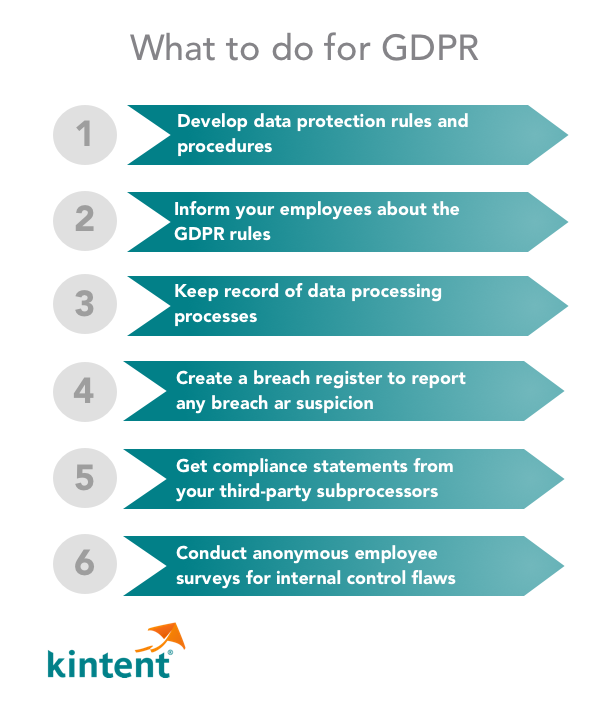
Steps to achieve GDPR compliance
Meeting the requirements of the General Data Protection Regulation (GDPR) is not a one-time task; it’s an ongoing process of building trust, protecting personal data, and aligning your business practices with regulatory expectations.
Organizations need to approach GDPR as both a legal obligation and a competitive advantage, since compliance signals transparency and accountability to customers, partners, and regulators.
- Understand What Data You Collect
Begin with a thorough assessment of the personal data your organization gathers, processes, or stores. Map data flows to see how information enters, moves through, and exits your systems. Identify the types of personal data (such as names, email addresses, IPs, or financial details) and the purposes for which they are used. - Establish a Legal Basis for Processing
GDPR requires organizations to clearly define why they are collecting personal data. This may be based on consent, contractual necessity, legal obligations, vital interests, public tasks, or legitimate interests. Document the justification for each data category so you can defend it if challenged. - Update Privacy Policies and Notices
Your privacy policy must explain, in plain language, what data is collected, how it is used, who it is shared with, and how individuals can exercise their rights. Transparency is central to GDPR, and poorly written or incomplete notices are a common area of non-compliance. - Strengthen Data Subject Rights Processes
Ensure you have reliable processes to respond to data subject requests such as access, correction, deletion (the “right to be forgotten”), data portability, and restriction of processing. These requests must be handled promptly, often within one month. - Implement Robust Security Controls
Adopt technical and organizational measures to protect personal data. This includes encryption, access controls, incident response planning, and regular audits. GDPR emphasizes “data protection by design and by default,” which means privacy must be considered at every stage of a system or process. - Conduct Data Protection Impact Assessments (DPIAs)
For high-risk processing activities, such as large-scale monitoring or handling sensitive personal data, carry out DPIAs. These assessments help identify risks to individuals’ rights and outline mitigation strategies before launching new projects. - Appoint a Data Protection Officer (DPO) if Required
Organizations engaged in large-scale monitoring or processing of sensitive data must appoint a DPO. This role oversees GDPR compliance, advises management, and acts as a point of contact for regulators and individuals. - Manage Third-Party Risks
Review contracts and relationships with vendors and partners who process personal data on your behalf. GDPR requires clear agreements and accountability to ensure third parties meet the same standards of protection. - Train Employees Regularly
Compliance depends on people as much as technology. Provide ongoing training for staff on data privacy principles, security practices, and their role in safeguarding information. - Monitor, Audit, and Improve
GDPR compliance is continuous. Regularly audit your processes, track regulatory updates, and refine policies to stay ahead of evolving requirements and business needs.
Read the “Mastering GDPR: A comprehensive guide to data protection principles” article to learn more!
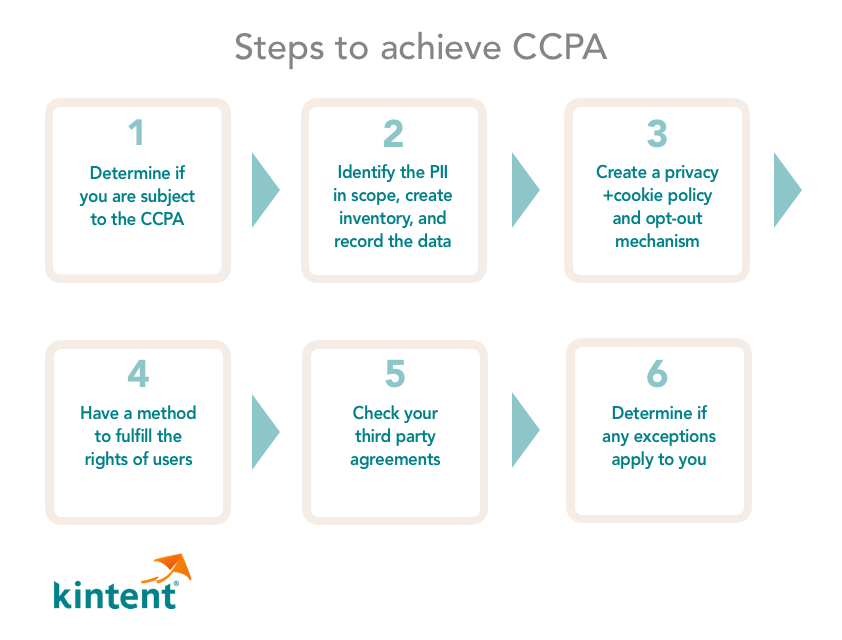
Steps to achieve CCPA
The California Consumer Privacy Act (CCPA) sets clear expectations for how businesses handle personal information of California residents. Achieving compliance is not just about avoiding penalties; it’s about showing customers that their data is respected and protected.
Unlike many privacy laws, the CCPA places strong emphasis on transparency and consumer choice, which means businesses must be proactive in reviewing how they collect, store, and share personal information.
- Identify and Classify Personal Information
Start by mapping the personal information your organization collects. This includes categories like names, email addresses, purchase histories, geolocation, and browsing behavior. Knowing exactly what data you hold and how it’s used is the foundation of CCPA compliance. - Update Privacy Notices and Disclosures
Your privacy policy must clearly describe the types of data collected, why it is collected, how it is shared, and whether it is sold. CCPA requires businesses to present this information in a way that consumers can easily understand, not buried in legal jargon. - Enable Consumer Rights Requests
Businesses must provide ways for consumers to exercise their rights: knowing what data is collected, requesting deletion, and opting out of the sale of their information. Create simple, accessible methods, such as web forms, dedicated phone numbers, or account settings, so requests can be handled quickly and effectively. - Implement “Do Not Sell My Personal Information” Mechanisms
If your business sells personal data, you must provide a clear and visible link on your website titled “Do Not Sell My Personal Information.” This allows consumers to opt out easily. Businesses must also respect the choices of consumers who have opted out. - Strengthen Data Security and Vendor Management
CCPA does not prescribe exact technical measures, but it expects businesses to safeguard personal data. Use encryption, access controls, and monitoring systems to reduce the risk of breaches. Review vendor agreements to ensure third parties also meet CCPA standards when processing data on your behalf. - Train Employees and Maintain Compliance Programs
Employees handling consumer data or responding to privacy requests should be trained on CCPA requirements. Compliance programs should include policies, recordkeeping, and regular reviews to ensure practices stay aligned with regulatory updates.
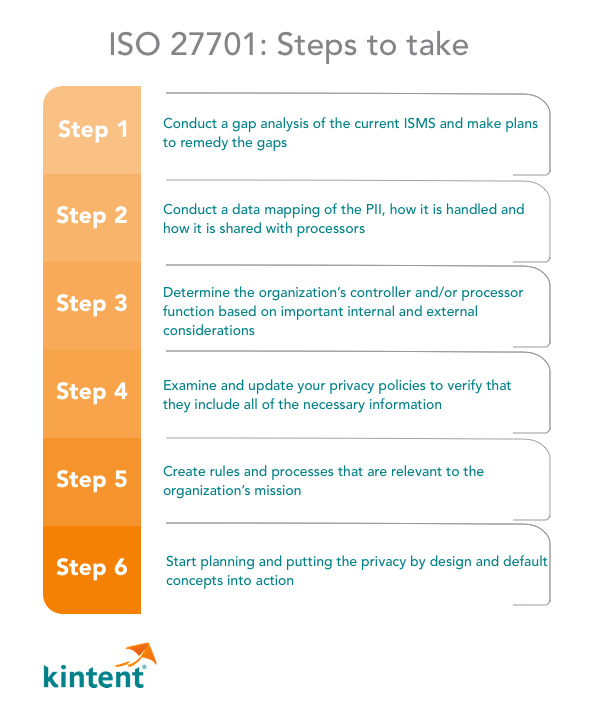
Steps to achieve ISO 27701 compliance
ISO/IEC 27701 builds on ISO 27001 and ISO 27002 to provide a framework for managing privacy information. While ISO 27001 focuses on information security, ISO 27701 extends those practices to include privacy management, helping organizations handle Personally Identifiable Information (PII) in line with global data protection laws like GDPR and CCPA.
Achieving ISO 27701 compliance is not just about certification; it’s about embedding privacy into daily operations and building lasting trust with stakeholders.
- Establish a Foundation with ISO 27001
Since ISO 27701 is an extension of ISO 27001, the first step is to either implement or already have ISO 27001 in place. This ensures you have a working Information Security Management System (ISMS) before layering on privacy requirements. - Define the Scope of Your Privacy Information Management System (PIMS)
Determine which business units, processes, and systems will be covered under the PIMS. Clear scoping avoids gaps and ensures privacy risks are addressed across the right areas of the organization. - Identify and Classify Personally Identifiable Information (PII)
Conduct a detailed data inventory to understand what PII you collect, process, and store. Classify the sensitivity of the data and identify whether your organization is acting as a data controller, processor, or both, since ISO 27701 provides role-specific requirements. - Develop Privacy Policies and Governance Structures
Create policies that outline how PII is collected, used, retained, and shared. Assign responsibilities to a privacy team or officer, and integrate privacy governance into broader risk and compliance frameworks. - Implement Risk Assessment and Controls
Assess privacy risks to individuals and apply controls to mitigate them. These include consent management, data minimization, access restrictions, encryption, and breach response procedures. ISO 27701 emphasizes “privacy by design and by default,” so controls must be built into operations. - Strengthen Third-Party and Vendor Management
Review contracts with processors, service providers, and partners to ensure privacy obligations are clearly defined. Vendors must be aligned with your PIMS to prevent weak links in compliance and security. - Provide Training and Build Awareness
Employees at every level must understand privacy obligations. Training should cover data handling practices, incident reporting, and consumer rights. Awareness programs foster a culture where privacy becomes part of everyday decision-making. - Monitor, Audit, and Continually Improve
Regularly review your PIMS through audits, internal assessments, and management reviews. Track regulatory updates, adjust controls when necessary, and drive continuous improvement to maintain compliance and readiness for certification.
Powering up privacy in your organization
Integrating GDPR, CCPA, and ISO 27701 principles into your organization can feel daunting, but a clear, structured approach makes the process manageable and effective. Privacy isn’t just compliance; it’s a strategic advantage that builds trust, protects data, and strengthens brand value. By embedding privacy principles into daily operations, businesses can proactively address risks, improve transparency, and ensure lasting compliance.
The following steps guide organizations toward building a robust privacy program, ensuring personal data is protected, regulatory obligations are met, and privacy becomes a core part of organizational culture.
- Conduct a comprehensive data audit
A thorough data audit is the foundation for any privacy initiative. Start by mapping personal data flows, identifying what data is collected, where it’s stored, and how it is processed. Include who has access to this data. This process reveals compliance gaps and vulnerabilities, enabling targeted actions. Regular audits ensure continued visibility and help maintain trust and accountability across all data handling processes. - Develop clear data protection policies
Privacy policies are the blueprint for protecting personal data. They should clearly outline how data is collected, stored, processed, and shared, aligning with GDPR, CCPA, and ISO 27701. Use plain language so employees, partners, and customers can understand their rights and obligations. Regular training reinforces awareness and ensures policies are applied consistently, embedding privacy into the organization’s culture. - Implement robust technical safeguards
Technical safeguards are critical to protecting personal data from breaches. Employ encryption, access control systems, intrusion detection, and regular security assessments. Keeping software updated ensures vulnerabilities are addressed promptly. A layered security approach helps ensure data protection in both storage and transmission. Strong technical safeguards not only meet compliance requirements but also strengthen customer confidence in your organization’s ability to secure sensitive information. - Establish a dedicated governance team
A dedicated privacy governance team is key to ongoing compliance. This team should have expertise in applicable laws and standards, enabling them to adapt quickly to regulatory changes. Responsibilities include enforcing policies, monitoring compliance, managing risks, and handling incidents. Centralized accountability ensures consistency, streamlines decision-making, and fosters a proactive approach to privacy, making it an integral part of business operations. - Embed privacy by design
Privacy by design means incorporating privacy considerations into every project, system, or service from the start. It ensures data protection isn’t an afterthought but a built-in feature. This approach aligns with legal requirements and reduces the cost of later remediation. Privacy by design strengthens stakeholder trust by demonstrating a proactive commitment to protecting personal data throughout its lifecycle. - Prepare for breach response
Even with the best safeguards, breaches can occur. A solid incident response plan is essential. This plan should include clear protocols for breach detection, reporting, mitigation, and communication. Conduct regular drills and simulations to test readiness. Quick, coordinated action minimizes damage, ensures regulatory compliance, and maintains stakeholder trust. A prepared organization can turn an incident into an opportunity to demonstrate resilience and responsibility.
GDPR, CCPA, ISO 27701, PCI & SOC 2 Privacy Criteria
Integrating GDPR, CCPA, and ISO 27701 into your organization
Integrating GDPR, CCPA, and ISO 27701 into an organization is essential for building a robust and sustainable data privacy framework. By harmonizing these regulations and standards, organizations can not only ensure compliance but also strengthen customer trust and operational resilience. A unified approach allows businesses to manage personal data efficiently, address privacy risks proactively, and demonstrate accountability to regulators, partners, and clients.
While challenges exist due to differing requirements, the common principles across these frameworks, such as transparency, accountability, and security, provide a strong foundation for a comprehensive data protection strategy.
- Data Mapping and Classification
The first step in integration is conducting a detailed data mapping exercise. This involves identifying all sources of personal data, categorizing it based on sensitivity, and tracing its flow within and outside the organization. Understanding data movement helps pinpoint vulnerabilities, comply with regulatory obligations, and streamline privacy management practices. A clear data map also supports effective risk assessment, reporting, and decision-making, forming the foundation for GDPR, CCPA, and ISO 27701 alignment. - Gap Analysis and Process Alignment
Once data mapping is complete, organizations should assess gaps between existing processes and regulatory requirements. GDPR and CCPA necessitate reviewing data collection, processing, storage, and sharing practices to ensure individual rights are respected. ISO 27701 requires aligning privacy management with the information security management system. Addressing these gaps may involve updating policies, assigning new roles, and implementing controls that mitigate privacy and security risks across the organization. - Training and Awareness Programs
Employee education is a critical component of compliance. Staff at all levels need to understand their responsibilities in safeguarding personal data. Regular training sessions, clear policy communication, and accessible resources create a culture of privacy awareness. Informed employees can act as the first line of defense against breaches and non-compliance, reducing risk while reinforcing accountability throughout the organization. Training programs also ensure consistent practices across departments, supporting regulatory adherence. - Leveraging Technology Solutions
Modern technology plays a key role in supporting integrated compliance efforts. Data management and security tools can automate access controls, encryption, and incident management, reducing reliance on manual processes and minimizing human error. Maintaining audit trails and automated reporting helps demonstrate compliance during regulatory inspections. Investment in technology not only enhances efficiency but also strengthens data protection, enabling organizations to respond rapidly to emerging risks and regulatory requirements. - Cross-Functional Collaboration
Integrating GDPR, CCPA, and ISO 27701 requires collaboration across departments like IT, legal, human resources, and operations. Establishing cross-functional compliance teams ensures that policies and practices are consistently applied. Regular internal audits and third-party evaluations help maintain alignment with regulatory standards, identify improvement areas, and promote continuous enhancement. A collaborative approach ensures that every process, role, and technology component works cohesively to protect personal data.
Effectively integrating GDPR, CCPA, and ISO 27701 transforms data privacy from a compliance obligation into a strategic advantage. By combining thorough data mapping, gap analysis, employee training, technology adoption, and cross-functional collaboration, organizations can create a resilient and accountable ecosystem. This approach safeguards personal data, strengthens stakeholder trust, and positions the organization to adapt to evolving privacy regulations while supporting sustainable growth and operational efficiency.
Moving forward
Even though GDPR concerns EU citizens’ personal data, and CCPA is there to protect the rights of Californians to have their personal information safe from abuse, the impact is global. For businesses, it is like crossing a bomb field if they decide to take their chance and not consider these regulations when operating.
One data breach can cost you thousands or even millions of dollars. Either you will lose millions of customers, or you will lose millions of dollars and you will get a reputation for letting a data breach occur. Either way, it’s not worth the risk.
Our advice to you is: don’t gamble! Start looking into the matter now. You’ll thank us later for letting you know.
If we are talking about complexity, the most complex of the three is the GDPR. Due to its scope of application, the nature and extent of collection limitations, and rules concerning accountability, it is the top headache for companies. So much so that some companies choose to refuse service for EU residents. The UK’s Information Commissioner’s Office (ICO) has developed self-assessment toolkits to ease the pain. It consists of several tools to help you assess your current status.
When doing business with Californians, the personal data rights of its residents are protected by CCPA and soon CPRA (The California Privacy Rights and Enforcement Act) as well. CPRA, also known as the CCPA 2.0, has been enacted and will go into effect in January 2023. Because the CPRA draws heavily on its predecessor, now is an excellent moment to begin complying with the CCPA if you have not already done so.
The ISO 27701 data privacy extension to ISO 27001 is generating a lot of buzz, particularly among firms considering ISO 27001 certification (or that are already ISO 27001 certified). If your organization is considering ISO 27001 certification and you recognize the importance of privacy and data security, it may make financial and strategic sense to expand the scope of your original ISO 27001 implementation to include the ISO 27701 controls by getting certified for both standards in a single audit.
How TrustCloud helps you achieve GDPR, CCPA & ISO 27701 compliance
TrustCloud simplifies the path to privacy compliance across multiple frameworks, including GDPR, CCPA, ISO 27701, and SOC 2, by delivering a unified, cost-effective solution. Instead of tackling each regulation separately, you get a consolidated set of controls that scales with your needs. It streamlines the process of building compliant systems, managing audits, and sharing your privacy posture with stakeholders.
Looking to build trust with your customers and fulfill your privacy obligations? Schedule a demo with us.
Summing it up
As you’ve seen, GDPR, CCPA, and ISO 27701 each set a different tone for data protection, but together, they offer a powerful playbook for building trust, safeguarding privacy, and strengthening your compliance program. The ideal path doesn’t involve juggling separate frameworks; instead, it’s about harmonizing their shared principles into one clear, sustainable strategy.
By aligning with all three standards, organizations gain more than risk mitigation; they earn credibility. Whether you’re responding to regulatory audits, working with global partners, or reassuring customers, this integrated approach streamlines operations while keeping personal data at the heart of your values.
Use this guide to navigate the foundations. When you’re ready to put it into practice, consider tools like TrustCloud that help unify policies, automate control mapping, and simplify evidence tracking across these compliance areas. You’ll move beyond checkboxes to real, ongoing confidence in how you protect data and uphold privacy.
FAQs
What is the difference between GDPR and CCPA?
The General Data Protection Regulation (GDPR) and the California Consumer Privacy Act (CCPA) are both designed to protect individual privacy, but they differ significantly in scope, geographic reach, and compliance requirements. GDPR is a comprehensive regulation that applies to any organization, regardless of location, that processes the personal data of individuals in the European Union. It emphasizes consent, lawful data processing, and strict accountability, with hefty penalties for non-compliance.
On the other hand, CCPA is a state-level law that protects the personal information of California residents. It focuses more on data transparency and consumer rights, such as the right to know what personal data is being collected, the right to delete that data, and the right to opt out of its sale. While GDPR is broader and more stringent, CCPA takes a more consumer-centric approach. Organizations doing business in both regions must understand and comply with both laws to avoid regulatory issues.
How does ISO 27701 help companies comply with privacy regulations?
ISO 27701 is a global privacy standard that extends ISO 27001 to address the management of personal data. It helps organizations build a structured Privacy Information Management System (PIMS) that aligns with major privacy laws such as GDPR, CCPA, and others. By implementing ISO 27701, companies can define clear roles and responsibilities for data privacy, implement security controls tailored for personal data, and document how data is collected, processed, stored, and shared.
This framework provides a comprehensive method for assessing privacy risks and building operational processes that support legal compliance. It ensures that data handling practices are transparent, auditable, and consistently enforced across departments. For organizations with global operations or plans to scale internationally, ISO 27701 offers a unified foundation to meet various regulatory demands efficiently, rather than managing multiple frameworks separately. Certification also demonstrates commitment to privacy to partners, customers, and regulators.
Why should companies invest in a structured privacy framework like ISO 27701?
Investing in a structured privacy framework like ISO 27701 offers long-term benefits beyond regulatory compliance. It establishes a culture of data protection and accountability across the organization, reducing the risks of data breaches, regulatory fines, and loss of customer trust. As privacy laws continue to evolve globally, having a standardized system makes it easier to adapt to new requirements without starting from scratch each time.
ISO 27701 also streamlines internal processes. It aligns legal, compliance, IT, and operational teams under one set of best practices, which enhances efficiency and reduces redundancies in data handling. Additionally, having a recognized certification like ISO 27701 can improve marketability by demonstrating a mature and proactive approach to data privacy, something that enterprise clients increasingly demand. For companies aiming to grow in privacy-conscious markets, this framework can be a strategic differentiator.
Who must comply with GDPR, and when does it apply?
GDPR applies to any organization, regardless of size or location, that processes the personal data of EU residents. This includes businesses offering goods or services to EU citizens or monitoring their online behavior. The regulation requires organizations to adopt strong data protection measures, document lawful processing grounds, and ensure transparency in data handling. It also mandates breach notifications within 72 hours and enforces “privacy by design,” meaning privacy controls must be built into business operations from the outset. In short, if your organization handles any data belonging to EU individuals, GDPR compliance is mandatory.
What rights do individuals gain under CCPA, and how must organizations respond?
Under the CCPA, California residents gain several data privacy rights. They can request to know what personal data a company collects, how it’s used, and with whom it’s shared. They can also request deletion of their data and opt out of the sale of personal information. Importantly, the CCPA prohibits businesses from discriminating against consumers who exercise these rights. To stay compliant, organizations must provide clear privacy notices, easy-to-use request mechanisms (like “Do Not Sell My Information” links), and timely responses to consumer inquiries. Training employees and ensuring vendor compliance are equally critical to meeting CCPA obligations.