
You may have heard about the Health Insurance Portability and Accountability Act, commonly known as HIPAA, and the industry-wide, standardized requirements it imposes on the confidential handling and protection of health information. If you’re not familiar with the subject matter, may we suggest you read our Introduction to HIPAA: The Only Guide You’ll EVER Need?.
In this post, we’re going to spend some time outlining the steps you should take when preparing for a HIPAA assessment and providing guidance around whether you even need an assessment in the first place.
Under HIPAA, companies in the healthcare space (which traditionally include healthcare providers, health plans and healthcare clearinghouses, but also include digital health startups) need to adhere to regulations on how to manage, store, and transmit protected health information (PHI). We should also mention that HIPAA is enforced by the United States Department of Health and Human Services’ (HHS) Office for Civil Rights (OCR).
The OCR is responsible for issuing annual guidelines to help companies identify and implement ‘the most effective and appropriate administrative, physical, and technical safeguards to secure electronically protected health information (ePHI).’ Under the Health Information Technology for Economic and Clinical Health Act (HITECH), the HHS is required to periodically audit Covered Entities and Business Associates.
That’s right, it’s the ‘always be ready’ rule. Like you didn’t already have enough problems…
What is the HITECH Act?
HITECH is a federal law that amends HIPAA (as part of the final omnibus rule) and is geared towards promoting the adoption of technology by healthcare providers, while also advocating for the improvement of privacy and security for IT systems and PHI.
Understanding HIPAA and third-party assessments
HIPAA establishes the standards that protect patient health information and sets forth the responsibilities of entities that handle such data. However, with the ever-changing landscape of cyber threats and evolving technologies, even well-established internal compliance programs may need external scrutiny. This is where third-party assessments come into play.
A HIPAA third-party assessment is an evaluation conducted by an independent organization or consultant that specializes in HIPAA compliance and security. Unlike internal audits that focus on day-to-day operations, these assessments provide an objective viewpoint to help organizations pinpoint vulnerabilities, improve current policies, and ensure that any vendors or business associates also adhere to HIPAA standards.
Organizations often outsource these assessments to benefit from fresh insight and expertise that may not be available in-house. With the tremendous risk associated with data breaches, relying solely on internal teams can be insufficient, making third-party assessments an essential part of a robust security strategy.
Looking for automated, always-on IT control assurance?
TrustCloud keeps your compliance audit-ready so you never miss a beat.
Learn MoreWhat is a HIPAA third-party assessment?
A HIPAA third-party assessment is a comprehensive evaluation process where an organization reviews the practices, policies, and technical controls of a third-party vendor to ensure they are compliant with HIPAA guidelines. These assessments are critical because even if a primary organization maintains a robust security infrastructure and administrative procedures, a lapse on the part of a partner can lead to a significant exposure of sensitive data.
These third-party assessments typically examine several key areas:
- Administrative safeguards
Policies and procedures that manage the selection, development, and oversight of security measures. - Physical safeguards
Controls involving the physical protection of electronic systems and the hardware storing sensitive data. - Technical safeguards
Security measures like encryption, access controls, and secure transmission protocols. - Organizational requirements
Accountability measures regarding workforce training, business associate agreements, and incident reporting.
For many healthcare organizations, these assessments are not one-off tasks but periodic evaluations that ensure ongoing compliance as systems update, policies evolve, and new vulnerabilities emerge. They are also an opportunity for vendors to demonstrate their commitment to data privacy and build trust with their clients.
Selecting the right third-party assessor
The effectiveness of a HIPAA assessment hinges on choosing a qualified and impartial assessor who understands the nuances of healthcare compliance.
Making the right selection ensures credibility, actionable insights, and stronger organizational trust.
- Verify accreditation and experience: Prioritize assessors with proven expertise in HIPAA, healthcare systems, and risk assessment methodologies.
- Ensure independence: Select assessors who can deliver unbiased evaluations, not internal teams or those with conflicting interests.
- Review methodology transparency: Ask for clear details on their approach, e.g., documentation scans, technical testing, interviews, and control validation.
- Evaluate report usefulness: Request sample assessments to ensure findings are detailed, prioritized, and include remediation steps, not just high-level checklists.
- Confirm ongoing support: Look for assessors that offer post-assessment guidance, follow-ups, and compliance roadmap assistance.
- Gauge compatibility with your culture: The assessor should collaborate smoothly with your internal teams and align with user-friendly, empathetic communication approaches.
Read the “Effortless HIPAA compliance for telemedicine success” article to learn more!
But what does always being ready mean for you?
We’re so glad you asked!
One of the ways you can ensure that you would successfully pass an audit by the OCR is to assess your systems, policies, and procedures in the same way the OCR would if they were auditing you. You can either do this yourself (commonly known as a self-assessment) or hire an external auditor to do it for you (commonly known as a third-party assessment). HIPAA doesn’t specifically require you to do annual assessments, nor does the OCR recognize “certificates” provided by private organizations, so beware of anyone saying otherwise.
If you choose to do an assessment, here is some helpful advice to get you started.
HIPAA Overview and Guides
Learn the basic concepts involved in the process of becoming HIPAA compliant with the security rule, and outline what you can expect as you work towards compliance.
What is a HIPAA third-party assessment?
A HIPAA third-party assessment is an in-depth evaluation performed by independent security and compliance experts to determine how effectively an organization safeguards protected health information (PHI). Unlike internal audits, these assessments offer an unbiased perspective, comparing your current safeguards against HIPAA’s Privacy, Security, and Breach Notification Rules.
The goal is to identify vulnerabilities, strengthen data protection measures, and ensure continuous compliance across administrative, technical, and physical layers of your organization.
- Independent, unbiased review
Third-party assessments bring external objectivity to the table. External auditors are not influenced by internal politics or assumptions, allowing them to identify overlooked risks and compliance gaps. Their impartial evaluation ensures a clearer understanding of your organization’s security posture and how well your current processes align with HIPAA requirements. - Evaluation of administrative safeguards
Auditors review the organization’s administrative policies and procedures, including employee training programs, risk management processes, and access control policies. This ensures that your organization has a governance structure capable of enforcing HIPAA standards effectively, minimizing the risk of human error or procedural negligence that could lead to a compliance breach. - Review of technical safeguards
Technical safeguards are a central focus of HIPAA assessments. Evaluators analyze data encryption, secure transmission channels, password management, and system access controls. They may also examine intrusion detection systems and firewalls to ensure that electronic PHI (ePHI) remains protected from unauthorized access both within and outside the network. - Examination of physical safeguards
Physical security measures are just as vital as digital ones. The assessment checks how facilities protect hardware and storage devices that contain PHI. This includes verifying that only authorized personnel can access restricted areas, ensuring proper disposal of old hardware, and confirming that physical documents are stored securely. - Vendor and business associate evaluation
Since many healthcare organizations rely on external vendors for data processing, storage, or telehealth services, auditors also review Business Associate Agreements (BAAs) and vendor security practices. Ensuring that third-party partners comply with HIPAA prevents downstream data exposure and strengthens the overall compliance ecosystem of your organization. - Detailed reporting and remediation roadmap
After the assessment, organizations receive a comprehensive report detailing compliance strengths, weaknesses, and prioritized recommendations. These findings often include a remediation roadmap outlining specific steps to close security gaps, improve incident response protocols, and enhance future audit readiness, empowering your team to maintain continuous HIPAA alignment.
A HIPAA third-party assessment acts as both a diagnostic and a strategic guide. It provides an impartial view of your compliance health, reveals areas that need reinforcement, and offers practical recommendations for improvement. Regularly conducting these assessments demonstrates accountability, builds trust with patients and partners, and ensures your organization’s long-term resilience in the ever-evolving landscape of healthcare security.
Read the “Empowering ultimate HIPAA telehealth compliance for secure remote healthcare” article to learn more!
Steps to conduct a HIPAA third-party assessment
Conducting a HIPAA third-party assessment is about building a transparent and verifiable framework for data protection. A well-structured assessment allows organizations to identify weaknesses, evaluate current safeguards, and implement targeted improvements to strengthen compliance.
By following a systematic approach, healthcare providers and business associates can ensure that every aspect of their operations from policies and procedures to technology and vendor relationships, meets HIPAA’s rigorous standards. The following steps outline how to plan, execute, and act on a third-party assessment effectively to maintain continuous trust and compliance readiness.
Step 1: Understanding requirements
Depending on the type of organization you are, you may have different obligations under HIPAA. Before you start, you need to understand which of the rules apply to you and scope the level of effort required by your team to meet those rules.
For example, to prove adherence to the privacy rule, you would need to show that you’ve implemented the proper controls, policies, and procedures to protect PHI from wrongful disclosure. Meanwhile, for the security rule, you would need to prove that you’ve implemented the appropriate administrative, physical, and technical safeguards.
Step 2: Information asset inventory
Once you’ve identified the HIPAA rule(s) that apply to you, it’s time to perform an inventory of all your information assets to see which relevant systems are housing PHI and ePHI and understand the risks that apply to them.
To make this a little more straightforward, here are two questions to keep in mind:
- Are there any external sources creating or coming into contact with PHI/ePHI?
For example, do any of your vendors or consultants create, receive, maintain, or transmit PHI/ePHI? - What are the human, natural, and environmental threats to information systems that contain PHI/ePHI?
The Security Rule requires companies to evaluate the risks and vulnerabilities in their environment. Companies and other entities must implement ‘reasonable and appropriate’ security measures to protect against any reasonably anticipated threats to the security of PHI and ePHI.
Once you’ve completed your inventory, the next step is to perform a risk assessment using your newly-compiled inventory (these are the systems housing PHI and ePHI.)
What is a risk assessment?
A risk assessment is an analysis of your entire business, against a particular standard or certification, to identify any gaps or weaknesses and provide you with an idea of where your risks and liabilities lie. We recommend conducting a risk assessment early on, as it will help you establish a baseline and prioritize remediating critical security gaps. Now would also be a good time to start thinking about controls you may want to adopt.
What are controls?
Controls are a way to express elements of risk that can impact your business and account for how these risks can be mitigated. You may need to adopt up to 75 controls for your HIPAA program.
Even if you don’t do an annual assessment, you should conduct a thorough risk assessment at least once a year to ensure that your systems are secure. If you use a compliance automation platform (and you should), you’ll be able to assess risk more frequently and effortlessly.
Read the “Top HIPAA violations to avoid for patient trust” article to learn more!
Step 3: Additional HIPAA requirement
Aside from assessing risks that exist in your company, HIPAA requires that you implement a number of processes. We’ve compiled a few of the more commonly requested requirements below:
Training Employees
As a first step, you should identify all employees that will come in contact with PHI. It would also be prudent to include those who would potentially come in contact with PHI as part of their job. Any employee who has exposure to PHI or ePHI should be trained in how to secure both. Their training should cover all the HIPAA safeguards: physical, technical, and administrative.
This training process must be documented and must be repeated annually. If you’re going with a self-assessment, you should keep this documentation on hand so you can provide it when requested by an auditor. For third-party assessments, this documentation lets your assessor know that you and your team are up-to-date on all the latest changes in the regulation and are using information security best practices.
Our recommendation is to work with an experienced vendor to administer the training. If you’re looking for guidance in this area, we’re happy to connect you with our partners. There may or may not be a discount involved. We were trying to be cheeky there. There is a one hundred percent discount.
Assigning roles and responsibilities to a privacy or security officer
As you may have noticed, adhering to HIPAA guidelines is a lot of work with a lot of moving parts. The best way to keep the flow of information under control is to assign a dedicated privacy or security officer, who can help keep track of all the moving parts and make sure the company is adequately communicating with vendors and employees regarding their obligations under HIPAA.
When you assign a privacy or security officer, they will:
- Monitor compliance with HIPAA security policies and procedures on an ongoing basis.
- Maintain, implement, and remain up-to-date on all policies, procedures, and documentation related to HIPAA security compliance. Think of it as being an airport traffic coordinator, keeping everything on time and on schedule.
- Ensure their fellow employees receive HIPAA training on policies and procedures.
Having a privacy or security officer can help manage your company’s HIPAA compliance. It’s a lot of information.
Documenting and reviewing policies and implementation
So your employees are trained. You’ve conducted inventory. What’s next?
It’s time to look at how you safely and securely protect digital or analog information by having documented, easily accessible policies and procedures.
As a company, securely protecting PHI in all its forms is your responsibility, so it’s a good idea to review all your policies at least annually.
What are policies?
Policies are the set of overarching rules that describe what you, as a company, are doing to mitigate the risk expressed by one or more related controls. As a general guideline, you may need to have up to 20 policies in place.
Some key policies include, but are not limited to:
- Risk management policy
- Incident response policy
- Business continuity policy
- Access control policy
- Asset management policy
Ensuring that all external vendors have signed a Business Associate Agreement (BAA)
A HIPAA BAA is a contract between a Covered Entity and a vendor (Business Associate or Subcontractor) used by that covered entity or by a Business Associate and its Subcontractors.
As a Business Associate, you will be asked to sign BAAs with the Covered Entities you work with or are looking to work with. Additionally, you may be working with external vendors (also known as Subcontractors) yourself to help you provide services to Covered Entities, and HIPAA applies to them too.
What is a Subcontractor?
A Subcontractor is an entity to whom a Business Associate delegates a function, activity, or service, other than in the capacity of a member of the workforce of the business associate. For example, a Business Associate could hire a media shredding company to securely dispose of printed medical records or a software developer to work on a part of the platform that handles PHI. Subcontractors can be accountants, attorneys, transcription services, email encryption providers, file sharing vendors, backup storage services, and more.
Under HIPAA, you will need to ensure that you sign BAAs with all subcontractors who come in contact with PHI.
Step 4: Conduct a HIPAA gap assessment
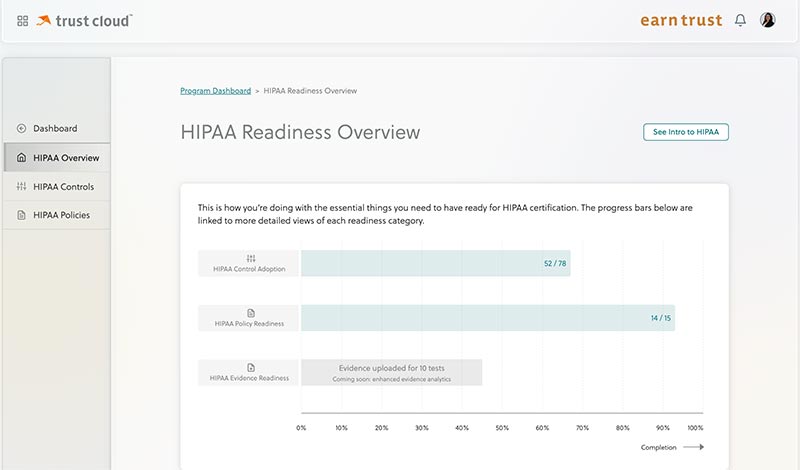
Working in a compliance automation tool gives you the flexibility to conduct periodic gap assessments to help track your overall progress towards HIPAA compliance. The idea is to perform regular comparisons in order to gauge how fast or slow your progress has been and plan your resources accordingly.
You might be thinking: gap assessments sound complicated; where do I even start? Well, typically, you start by paying a consultant a large sum of money. As an alternative, may we suggest an easy-to-use, joyful compliance automation tool like TrustOps? Exactly like it, in fact. TrustOps helps you adopt, implement, and test controls and effortlessly maps them to HIPAA requirements.
Here’s what a gap assessment for HIPAA looks like in TrustOps:

Step 5: Evidence collection
Finally, it’s time to show your work! Or rather, get your work to a state where it’s ready to be reviewed. The assessor wants to see proof that you’ve implemented all relevant security requirements, training exercises, policies, and procedures.
A good rule of thumb: if you’ve done something, make sure you have the documentation to prove that it was done. If you trained your employees, keep records listing the type of training, the date the training took place, and any certifications earned, and even consider booking an appointment with the employees who went through the training so they can speak directly with the auditor. You want to be as thorough and detailed as possible.

If you’re using a compliance automation tool (and by now you really should be), it will automatically collect evidence, log activities (such as tests), and compile documents (such as policies and procedures). If running around like a headless chicken is more your style, however, then by all means, open your favorite spreadsheet software and start writing.
Read the “Reporting HIPAA violations: a step-by-step guide” article to learn more!
Turning assessment findings into actionable strategy
A third-party HIPAA assessment delivers true value only when its findings translate into measurable improvements. The goal is to move from identifying compliance gaps to building a proactive, evolving strategy that strengthens data security and operational resilience.
By prioritizing remediation, enhancing accountability, and embedding lessons learned into everyday practices, organizations can transform assessment insights into a continuous cycle of compliance and trust.
- Prioritize remediation based on risk
Not all findings carry equal weight. Begin by classifying issues according to their potential impact on protected health information (PHI). Address high-risk vulnerabilities first, especially those that expose sensitive data or violate core HIPAA standards. A risk-based prioritization ensures limited resources are directed toward the most critical gaps, reducing exposure faster and more effectively. - Develop a detailed remediation roadmap
Create a structured roadmap that outlines each remediation task, assigns ownership, and sets clear timelines. This roadmap should include deliverables, milestones, and success metrics for every control gap identified during the assessment. Documenting these elements builds accountability and helps leadership track progress toward achieving full compliance and strengthening the organization’s security posture. - Use automation tools for tracking
Leverage workflow automation and compliance management software to streamline remediation tracking. These tools allow teams to log corrective actions, attach supporting evidence, and monitor progress in real time. Automated alerts and dashboards improve transparency and cross-functional collaboration, ensuring that remediation activities stay on schedule and that no compliance task falls through the cracks. - Embed updates into policy reviews
Assessment findings should inform broader organizational improvements. Integrate new insights into policy updates, security awareness training, and procedural revisions. Embedding these updates ensures that improvements are not one-time fixes but part of a sustained compliance culture. It also reinforces alignment between documented policies and the organization’s day-to-day security practices. - Schedule periodic reassessments
HIPAA compliance is an ongoing commitment, not a one-off event. Schedule regular reassessments or readiness checks to validate that previous remediation efforts remain effective. Continuous validation helps identify emerging risks, ensures controls are functioning as intended, and prepares the organization for future audits or regulatory reviews with minimal disruption. - Report to leadership and stakeholders
Transparent reporting ensures continued support and accountability. Present progress through executive summaries, compliance dashboards, or board updates. Highlight resolved risks, improvements in compliance maturity, and ongoing challenges. Regular communication not only maintains leadership buy-in but also reinforces the organization’s dedication to safeguarding patient information and maintaining regulatory trust.
Once you’ve finalized all your evidence, you’re ready for your assessment! Your documents are all in order, everyone is trained, and you’re feeling confident. The next step is to decide: do you go with a self-assessment or choose an independent third-party assessor?
But that, our friends, is a topic for another blog post. May we suggest “How to choose your independent assessor” or “What does an assessor look like?“
Prove how your security program protects your business and drives growth
Showcase financial liability reduction with IT risk quantification, cut costs while automating 100s of manual security and GRC workflows, and accelerate revenue by earning regulator, auditor and customer trust.
Strengthening trust through smarter vendor assessments
A third-party assessment is more than a compliance checkbox; it’s a chance to strengthen partnerships, reduce risk, and protect patient trust. These five practical steps help ensure your assessments are meaningful, actionable, and aligned with HIPAA’s expectations:
- Establish a Clear Baseline for Risk
Start with a clear understanding of your current risk posture. Conduct a baseline assessment of your own environment, and use that insight to evaluate whether prospective vendors raise your overall risk levels or introduce unexpected gaps. - Vet Third Parties Beyond Contracts
A signed Business Associate Agreement (BAA) is necessary but not sufficient. Effective assessments require reviewing a vendor’s actual security practices: their training programs, access controls, incident response plans, and how they manage downstream subcontractors. - Prioritize Vendors by Criticality
Not all third parties carry the same risk. Segment vendors into tiers based on how much PHI they handle or impact your operations. Heavily scoped vendors deserve deeper reviews; low-impact ones may need lighter, but still consistent, attention. - Use Structured Risk Scoring
Turn assessments into decisions. Use a standardized risk scoring model that captures factors like technical controls, past incidents, and compliance maturity. Scores make it easier to compare vendors and flag priorities for deeper review or remediation. - Plan for Continuous Oversight, not one-off checks
HIPAA compliance isn’t a snapshot; it’s an ongoing commitment. Build regular check-ins into your process, especially when vendors launch new features, change hands, or evolve technically. A quarterly review cadence, backed by automated monitoring, keeps risk visible and manageable.
Read the “Securing electronic health information: 7 points checklist to HIPAA security rule compliance” article to learn more!
Common challenges during HIPAA third-party assessments
While the benefits of a HIPAA third-party assessment are undeniable, the process can uncover practical and cultural hurdles that slow progress. Many organizations struggle to balance day-to-day operations with compliance preparation, while others face technical, financial, or attitudinal barriers.
Understanding these challenges in advance allows organizations to plan strategically, allocate resources efficiently, and foster a culture of continuous compliance rather than reactive fixes.
- Resource constraints
Smaller healthcare providers or teams with limited budgets often struggle to dedicate sufficient staff, time, and funds for HIPAA assessments. Compliance efforts may compete with operational priorities, delaying progress. However, neglecting compliance can lead to costly penalties and reputational damage, making early resource allocation and efficient planning critical to long-term sustainability and risk reduction. - Cultural resistance
Change can be difficult, especially when it alters established workflows. Employees and management may resist new policies if they view them as burdensome or unnecessary. Overcoming this challenge requires clear communication, leadership support, and employee training to reinforce that compliance strengthens both patient trust and organizational resilience, not just regulatory obligation. - Complex vendor ecosystems
Many healthcare organizations rely on third-party service providers for data storage, billing, or telehealth operations. Each vendor introduces potential compliance risks. Assessing and validating their adherence to HIPAA requirements can be time-consuming and complicated. Establishing strict vendor management policies, contractual clauses, and regular audits helps ensure that all partners uphold the same security standards. - Data fragmentation
When patient data resides across multiple systems, cloud environments, or legacy databases, gaining full visibility into where PHI is stored and how it’s protected becomes challenging. This fragmentation increases the risk of oversight during assessments. Consolidating data repositories and mapping data flows in advance can help ensure a complete, accurate evaluation of security controls. - Limited internal expertise
Not all organizations have in-house experts who deeply understand HIPAA’s technical and administrative safeguards. Misinterpretation of requirements or incomplete implementation of controls can lead to compliance gaps. Partnering with experienced assessors, leveraging automation tools, or providing compliance training to staff can bridge these knowledge gaps and strengthen internal capabilities. - Documentation gaps
Inadequate or outdated documentation is a frequent pain point. Assessors rely heavily on written evidence, policies, procedures, and access logs to evaluate compliance maturity. Without current documentation, even compliant practices may appear deficient. Maintaining well-organized, regularly updated records ensures smoother assessments and demonstrates an organization’s commitment to transparency and accountability.
Every HIPAA third-party assessment presents unique challenges, but each obstacle offers a chance to strengthen compliance maturity. By addressing resource, cultural, and technical barriers proactively, organizations can turn the assessment process into a strategic advantage. With the right planning, communication, and expert support, these challenges become stepping stones toward stronger data security and patient trust.
Read the “Boost trust with HIPAA compliance: proven strategies for healthcare” article to learn more!
The human element in third-party compliance
While automated systems and standardized processes are central to conducting HIPAA third-party assessments, the human element remains equally important. Effective compliance is as much about relationships as it is about technology and documentation.
Establishing trust with vendors, ensuring transparent communications, and cultivating a culture of ownership around data security are all human-centric aspects of compliance management. Regular training sessions, joint risk workshops, and open forums for discussion can bridge the gap between policy and practice. These initiatives help demystify complex regulations and foster a sense of shared responsibility among all stakeholders.
Furthermore, when issues arise, having a direct line of communication with key individuals can facilitate rapid responses and innovative problem-solving strategies. In many ways, the human element transforms regulatory compliance from a burdensome checkbox exercise into a collaborative, dynamic process that continuously adapts to an ever-changing landscape.
Future trends in HIPAA compliance and third-party assessments
As technology evolves and new cyber threats emerge, the landscape of HIPAA compliance and third-party assessments will continue to shift. In the coming years, organizations may witness increasing automation in compliance processes, including the use of artificial intelligence (AI) and machine learning to monitor vulnerabilities and analyze compliance patterns.
Additionally, more integrated risk management platforms are likely to simplify the complexities of regulatory requirements by providing real-time dashboards, predictive analytics, and continuous monitoring capabilities. This means that third-party assessments might soon shift from being periodic “snapshot” evaluations to ongoing, integrated parts of an organization’s overall security strategy.
Moreover, with the healthcare industry moving rapidly towards digital health records and telemedicine, there is a growing need for enhanced data sharing protocols and more robust privacy safeguards. Future assessments may place greater emphasis on data interoperability and ensuring that new technologies align with HIPAA requirements.
Organizations that are proactive and adaptive to these changes will not only remain compliant but will also gain significant advantages in building trust with patients and stakeholders. An adaptive approach to HIPAA compliance fosters a resilient framework capable of absorbing and thriving amid emerging challenges.
Summing it up
A thorough HIPAA third-party assessment is more than a compliance check; it’s a proactive strategy to safeguard patient data and maintain trust throughout your digital ecosystem. By clearly defining assessment scope, verifying service provider controls, and addressing observed gaps, you build a stronger compliance posture and reduce downstream risk exposure.
The goal isn’t just to “pass” an assessment but to elevate your third-party ecosystem into a resilient, transparent extension of your organization. When executed with clarity, oversight, and accountability, these assessments become a strategic advantage, strengthening your reputation, enhancing data protection, and ensuring regulatory confidence.
FAQs
Why should organizations use an independent third-party for HIPAA assessments?
Using an independent third-party assessor strengthens both credibility and objectivity in evaluating HIPAA compliance. While organizations can self-attest, third-party audits offer a neutral perspective, helping uncover gaps that internal teams may overlook due to familiarity or bias. Independent assessors bring proven methodologies, documentation review, and control testing that align with HIPAA regulations. Their objective findings can reassure stakeholders, such as partners, payers, or regulators, that your risk posture is genuine and rigorous. Ultimately, third-party assessments elevate trust and accountability in your compliance program, providing a confidence boost beyond what a self-audit can deliver.
How should organizations choose a reliable HIPAA assessment partner?
Selecting the right third-party assessor hinges on accreditation and alignment with HIPAA standards. Look for assessors with a strong track record in healthcare audits, a transparent assessment methodology, and the ability to thoroughly review your policies, security controls, and practices. Request sample reports to evaluate the quality of findings and recommendations. Ensure the assessor offers clear documentation, a gap analysis, and realistic remediation guidance. Ask whether they provide follow-up support, such as virtual reassessments or audit coaching, so you can maintain compliance over time. Choosing an impartial yet experienced partner ensures accuracy and builds trust both internally and externally.
How often should I plan for HIPAA third-party assessments?
HIPAA neither mandates nor prohibits yearly third-party assessments, but industry best practices recommend annual or periodic reviews to maintain strong compliance and adapt to changing threats. High-frequency assessments help detect new vulnerabilities, enforce control updates, and validate that remediations remain effective. Even if significant changes aren’t underway, a “health check” reassessment keeps documentation current and processes audited. Organizations also facing mergers, vendor changes, or rapid growth may benefit from more frequent reviews to ensure evolving data flows remain protected under HIPAA’s Privacy and Security Rules.