
Building a Customer Assurance & Continuous Control Monitoring Program that earns customer trust. Access on-demand →

Powerful guide to choosing SOC 2 vs ISO 27001: make the right security decision

Richa Tiwari

Sep 18, 2025

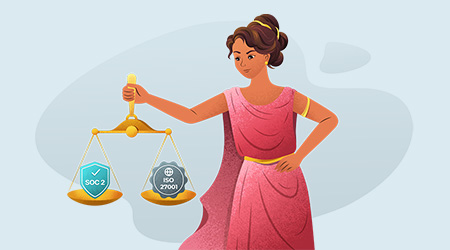
Themis holding a scale with SOC 2 & ISO 27001

When it comes to demonstrating security and compliance maturity, many organizations find themselves asking the same question: Should we pursue SOC 2 or ISO 27001?

Both frameworks are highly respected in the world of information security and risk management. However, they differ in purpose, scope, geographic recognition, and implementation requirements. Choosing the right one depends on your company’s structure, target customers, industry demands, and even how much time and budget you have to dedicate to certification.

SOC 2 is a U.S.-centric framework focusing on the protection of customer data, particularly relevant for service organizations handling sensitive information. It evaluates how well a company manages data based on five Trust Service Criteria: Security, Availability, Processing Integrity, Confidentiality, and Privacy.

On the other hand, ISO 27001 is an internationally recognized standard that provides a systematic approach to managing sensitive company information, encompassing people, processes, and IT systems. It requires organizations to establish, implement, operate, monitor, review, maintain, and improve an Information Security Management System (ISMS).

This article delves into the distinctions between SOC 2 and ISO 27001, exploring their unique benefits, implementation processes, and how to determine which aligns best with your organization’s needs. Whether you’re aiming to expand your market reach or bolster your security framework, understanding these standards will guide you in making an informed decision.

What is SOC 2?

SOC 2 (System and Organization Controls 2) is a security and compliance framework developed by the American Institute of Certified Public Accountants (AICPA). It is specifically designed for service providers that handle customer data, ensuring they manage and protect this information securely.

SOC 2 focuses on five Trust Service Criteria (TSCs)

  1. Security: Safeguarding systems and data from unauthorized access.
  2. Availability: Ensuring systems are operational and accessible as promised.
  3. Processing integrity: Delivering accurate, complete, and timely services.
  4. Confidentiality: Protecting sensitive business information from unauthorized disclosure.
  5. Privacy: Handling personal data responsibly and in line with privacy regulations.

SOC 2 reports are often requested by clients and partners as proof that a company has the right controls in place to secure their data. For businesses, achieving SOC 2 compliance builds trust, credibility, and competitive advantage in the marketplace.

TrustCloud
TrustCloud

Looking for automated, always-on IT control assurance?

TrustCloud keeps your compliance audit-ready so you never miss a beat.

Learn More

What is ISO 27001?

ISO 27001 is an internationally recognized standard for information security management, developed by the International Organization for Standardization (ISO) and the International Electrotechnical Commission (IEC). It provides a systematic framework for establishing, implementing, maintaining, and continually improving an Information Security Management System (ISMS) to protect sensitive information.

ISO 27001 focuses on identifying risks to information security and implementing a structured set of controls to mitigate them. These controls address areas such as people, processes, and technology, ensuring that security measures are comprehensive and adaptable to evolving threats.

Key features of ISO 27001 include

  1. Risk-based approach: Organizations assess and treat security risks specific to their environment.
  2. Information security policies: Clear guidelines on protecting information.
  3. Continuous improvement: Regular audits and reviews to adapt the ISMS to changing threats.
  4. Global recognition: ISO 27001 certification is respected worldwide, making it especially valuable for international business.

For businesses, achieving ISO 27001 certification demonstrates a strong commitment to information security, builds customer trust, and can provide a competitive advantage in markets where security is a key differentiator.

Key factors to consider when choosing between SOC 2 and ISO 27001

Choosing between SOC 2 and ISO 27001 is about aligning your security certification with the realities of your business and the expectations of your market.

SOC 2

The right framework depends on multiple dimensions: how your organization is structured, the industry you serve, where your clients are located, and even how quickly you need results. Cost, stakeholder demands, and long-term vision also play pivotal roles. To make the decision clearer, let’s break down the key factors that should guide your choice between SOC 2 and ISO 27001.

  1. Organizational structure and size
  2. Industry expectations
  3. Geographic considerations
  4. Time to achieve compliance
  5. Cost considerations
  6. Client and stakeholder demands
  7. Long-term strategy

SOC 2 Overview and Guides

A comprehensive introduction to the SOC 2 compliance readiness process, essential for SaaS vendors in the United States.

Read More

Read the “Confidently choose your SOC 2 trust service criteria” article to learn more!

Organizational structure and size

When evaluating SOC 2 versus ISO 27001, the size and structure of your organization play a crucial role in determining which framework is the better fit.

SOC 2 and lean organizations

SOC 2 is particularly attractive to startups, SaaS providers, and mid-sized businesses that want to demonstrate their commitment to data security without completely overhauling how they operate. For these companies:

  1. Flexibility is key
    SOC 2 does not force you to implement an entire management system across the organization. Instead, it focuses on specific controls related to the five Trust Services Criteria. This allows smaller teams to remain agile while still proving security maturity to customers.
  2. Speed matters
    Startups often work under intense pressure to close deals and gain market traction. A SOC 2 Type I report can sometimes be achieved within months, helping young companies quickly meet customer demands.
  3. Minimal disruption
    Since SOC 2 audits are scoped to relevant systems and processes, they require fewer organizational changes compared to ISO 27001, which can be overwhelming for lean teams with limited bandwidth.

In other words, SOC 2 allows smaller, fast-moving companies to showcase credibility in the U.S. market without needing enterprise-level structures in place.

ISO 27001 and complex enterprises

ISO 27001, on the other hand, is a natural fit for larger enterprises, regulated industries, or companies with global aspirations. For these organizations:

  1. Comprehensive coverage
    ISO 27001 requires the creation of an Information Security Management System (ISMS). This system governs not just IT but also policies, risk management, documentation, training, and governance across departments.
  2. Structured accountability
    Larger companies often have multiple departments, IT, HR, legal, compliance, and operations, each handling sensitive information. ISO 27001 provides a framework for aligning all these functions under a single security management umbrella.
  3. Continuous improvement
    ISO 27001 emphasizes ongoing monitoring, audits, and improvements. This approach is ideal for mature organizations that want to integrate security into their culture rather than treat it as a one-time compliance exercise.
  4. Regulatory alignment
    Enterprises in industries like finance, healthcare, or government contracting often face multiple compliance obligations. ISO 27001 offers a structured backbone that makes it easier to layer on other certifications and standards.

For large and regulated organizations, ISO 27001 is more than a certificate; it’s a governance tool that strengthens security posture across the entire company.

So, if your company is small, agile, and focused on winning trust quickly particularly in the U.S. SOC 2 is likely more manageable and aligned with your business reality. If your company is established, complex, or preparing for international growth, ISO 27001 provides a stronger foundation that integrates security deeply into your organizational DNA.

Industry expectations

The industry you operate in often dictates whether SOC 2 or ISO 27001 carries more influence. While both frameworks signal a strong security posture, different sectors have unique compliance cultures and expectations from vendors.

Technology & SaaS

In the technology and SaaS ecosystem, especially within the United States, SOC 2 has become the de facto standard.

  1. Customer demands
    Large enterprises, particularly in software procurement, will frequently request a SOC 2 report before they even consider signing contracts. It has become part of the sales cycle, a gatekeeper requirement in vendor due diligence.
  2. Speed to market
    Fast-growing SaaS companies that rely on B2B contracts find SOC 2 invaluable because it offers a quick way to prove that their controls meet industry expectations without requiring full-scale ISO certification.
  3. Familiarity in the ecosystem
    SOC 2 has become a common language in the U.S. tech world—customers, investors, and even procurement teams know what it means and are often trained to look for it.

For startups and mid-sized SaaS providers, not having SOC 2 can result in delayed deals or outright disqualification during the vendor selection process.

Finance, healthcare, and government contractors

Highly regulated industries such as finance, healthcare, defense, and government contracting place a stronger emphasis on structured governance and international standards.

  1. ISO 27001 recognition
    ISO 27001 certification demonstrates not just that you have controls in place but also that your organization has a comprehensive Information Security Management System (ISMS). This aligns well with the stringent compliance obligations in these industries.
  2. Mandatory certification
    In many cases, particularly in Europe and Asia, ISO 27001 is a mandatory requirement for suppliers in regulated sectors. Banks, insurance companies, and hospitals may explicitly ask for ISO certification before onboarding a vendor.
  3. Integration with regulatory frameworks
    ISO 27001 maps more naturally to regulations like GDPR (in Europe) or frameworks such as HIPAA (healthcare in the U.S.) and helps organizations demonstrate accountability across legal and compliance landscapes.

For organizations dealing with sensitive financial data, personal health information, or government systems, ISO 27001 is often the gold standard.

Supply chain & manufacturing

In manufacturing, logistics, and supply chain management, ISO 27001 tends to be the stronger option due to its structured, integrated approach.

  1. Alignment with other ISO standards
    These industries often rely on multiple certifications to ensure operational excellence and resilience. For instance:
    1. ISO 9001 (Quality Management Systems)
    2. ISO 22301 (Business Continuity Management)
    3. ISO 14001 (Environmental Management)
      Because ISO 27001 shares a similar structure with these standards (thanks to the Annex SL framework), it integrates seamlessly, reducing redundancy in audits and documentation.
  2. Resilience focus
    Supply chains deal with physical and digital risks. ISO 27001’s risk-based approach ensures organizations can identify, assess, and manage disruptions effectively.
  3. International recognition
    Global manufacturing networks depend on international credibility. ISO 27001 offers a level of assurance that resonates with multinational partners and regulators.

For supply chain players, ISO 27001 not only strengthens security but also streamlines compliance across multiple management systems.

Your industry’s compliance culture often has the final say:

  1. In technology and SaaS, especially in the U.S., SOC 2 is the currency of trust.
  2. In finance, healthcare, or government contracting, particularly in global contexts, ISO 27001 certification carries more weight.
  3. In manufacturing and supply chain ecosystems, ISO 27001’s structured integration with other standards makes it the natural choice.

Organizations should closely examine their target clients and sector expectations to ensure they pursue the framework that best aligns with industry norms.

Read the “SOC 2 Type 2 compliance checklist: Step-by-step guide for 2025” article to learn more!

Prepare to pass your ISO 27001 audit

A successful ISO 27001 audit shows customers and prospects that you’re serious about protecting their data. TrustCloud helps you achieve ISO 27001 certification faster, with less stress on each subsequent audit.

Geographic considerations

Where your organization operates, and where your customers are located, plays a significant role in whether SOC 2 or ISO 27001 is the better fit. Each standard carries different levels of recognition and influence depending on the region.

North America (Especially the U.S.)

In the United States, SOC 2 reigns supreme as the most widely recognized framework for demonstrating security maturity.

  1. Customer familiarity
    U.S. procurement teams, investors, and enterprise clients often explicitly request a SOC 2 report. It has become the default “proof of security” in tech, SaaS, and service-provider ecosystems.
  2. Investor expectations
    Many venture capital firms and private equity investors in the U.S. view SOC 2 compliance as a milestone for startups. It signals that the company is ready to scale and handle enterprise-level clients.
  3. Market speed
    Because U.S.-based companies often prioritize time-to-market, SOC 2’s faster path to compliance (especially with a Type I report) makes it highly attractive.
    If your business model is primarily focused on U.S. clients, SOC 2 offers the most immediate recognition and return on investment.

Europe, Asia, Middle East, and Africa

Outside the U.S., ISO 27001 holds stronger recognition as a truly international security standard.

  1. European expectations
    In the EU, ISO 27001 is widely seen as the benchmark for security compliance. It aligns with the General Data Protection Regulation (GDPR), making it a natural choice for organizations that handle European personal data.
  2. Global supply chains
    Multinational corporations in Asia, the Middle East, and Africa often require ISO 27001 certification from vendors. Its international scope and formal certification process give it greater weight in procurement and due diligence.
  3. Government and regulated sectors
    Many government contracts and highly regulated industries across these regions mandate ISO 27001 certification as part of their supplier requirements.

If your company is expanding into EMEA or APAC regions, ISO 27001 is far more persuasive and opens more doors than SOC 2.

Global expansion

For organizations with ambitions to serve clients across multiple geographies, ISO 27001 typically offers broader, long-term benefits.

  1. Universal language
    ISO standards are recognized and respected worldwide, making ISO 27001 a credential that transcends borders.
  2. Consistency
    A single ISO 27001 certification can support global sales and partnerships, whereas SOC 2 may require additional explanations or supplementary certifications outside the U.S.
  3. Scalability
    ISO 27001 provides a framework for managing information security across global operations, supply chains, and subsidiaries, making it easier to scale security governance consistently.

SOC 2 can still be valuable for U.S.-focused sales, but ISO 27001 ensures your compliance strategy won’t hit barriers as you expand internationally.

If your customer base is primarily U.S.-centric, SOC 2 is the more powerful and relevant credential, if your business involves international clients, regulated industries, or global supply chains, ISO 27001 carries stronger recognition and credibility.
For organizations with a hybrid or global strategy, many choose to pursue both: SOC 2 to meet U.S. market demands and ISO 27001 to gain worldwide trust.

Read the “ISO 27001 preparation time for companies of different sizes” article to learn more!

Time to achieve compliance

The time it takes to achieve compliance is often a deciding factor, especially for companies under pressure to close deals or meet client requirements. SOC 2 and ISO 27001 differ significantly in timelines because of the depth and scope of what each framework demands.

SOC 2 Type I: A Fast Track to Credibility

SOC 2 Type I reports are designed to verify that you have appropriate controls in place at a single point in time.

  1. Timeline
    Many organizations can achieve Type I compliance in as little as 2–3 months, depending on their existing security posture.
  2. Effort required
    You’ll need to document your policies, establish your control environment, and show auditors that the required safeguards exist, even if they haven’t been tested over time yet.
  3. Best suited for
    Startups and fast-growing SaaS companies that want to quickly provide evidence of security practices to clients or investors.

This makes SOC 2 Type I a practical option for companies seeking a near-term compliance win.

SOC 2 Type II: Proof Over Time

SOC 2 Type II reports provide stronger assurance because they demonstrate that your controls are operating effectively over a period of time, typically 6 to 12 months.

  1. Timeline
    Preparing for and completing a Type II audit can take 6–12 months, depending on the length of the audit window you choose.
  2. Effort required
    Beyond documentation, your organization must consistently apply security controls, gather evidence over time, and prove to auditors that practices are not just designed well but actually followed.
  3. Best suited for
    Companies that want to differentiate themselves in competitive markets and need a higher level of trust from enterprise clients.

Type II requires more patience, but it carries significantly more credibility with discerning customers.

ISO 27001: Building a System for the Long Run

ISO 27001 is a heavier lift because it requires organizations to build and maintain an Information Security Management System (ISMS). This is not just about implementing controls but about embedding security governance into the company’s DNA.
Timeline: Achieving ISO 27001 certification can take 6–18 months, influenced by factors such as:

  1. The maturity of your existing security policies and processes
  2. The size and complexity of your organization
  3. Internal resources available for implementation
  4. Effort required: You’ll need to conduct a full risk assessment, identify security objectives, establish governance frameworks, document processes, provide training, and undergo a formal certification audit.
  5. Best suited for: Larger enterprises, regulated industries, and organizations that want to build a long-term security culture with continuous improvement.

While it takes longer, ISO 27001 delivers a comprehensive, globally recognized certification that positions your organization for growth and resilience.

If you need speed and short-term credibility, SOC 2 Type I is your fastest option. If you want to show operational consistency over time, SOC 2 Type II offers stronger assurance within about a year. If you’re willing to invest in a robust, long-term security framework with global recognition, ISO 27001 is worth the wait. Ultimately, your decision depends on whether your immediate priority is closing deals quickly or building a security program that scales internationally and stands the test of time.

Read the “Master SOC 2 compliance with confidence and ease” article to learn more!

Cost considerations

Budget plays a major role in choosing between SOC 2 and ISO 27001. While both frameworks require financial investment, the type of costs, how they scale, and how they impact your organization differ significantly.

SOC 2: Flexible but Recurring Costs

SOC 2 audits are priced according to the type of report (Type I or Type II), the scope of systems covered, and the auditing firm’s rates.

  1. SOC 2 Type I
    Typically ranges from $15,000–$30,000. Since it only evaluates controls at a point in time, it’s less intensive and therefore less expensive.
  2. SOC 2 Type II
    More comprehensive, requiring evidence collection over months, and usually costs $30,000–$50,000 or more. Larger organizations or those with complex IT environments may see higher costs.
  3. Annual renewals
    SOC 2 reports are valid for only a year, meaning organizations must undergo the audit annually to keep documentation current. This makes SOC 2 an ongoing expense, not a one-time cost.
  4. Additional costs
    Some organizations may invest in readiness assessments, compliance automation tools, or consultant support to speed up the audit process.
    Summary: SOC 2 offers a lower upfront investment, but the need for yearly renewals means costs add up over time.

ISO 27001: Larger Investment, Broader Returns

ISO 27001 is more resource-intensive and requires a larger financial and organizational commitment.

  1. Certification audit
    Costs generally range from $25,000–$75,000 or more, depending on organization size, number of sites, and the complexity of operations.
  2. Implementation costs
    Beyond the certification audit, organizations need to build an Information Security Management System (ISMS). This may involve:
    1. Hiring consultants to guide implementation
    2. Investing in risk assessment tools
    3. Developing training programs
    4. Allocating significant internal staff time
  3. Surveillance audits
    ISO 27001 certification isn’t a one-and-done exercise. Accredited certification bodies require annual surveillance audits to ensure ongoing compliance, adding recurring costs. Every three years, a full recertification audit is required.
  4. Opportunity costs
    ISO 27001 demands significant involvement from management, IT, compliance, and HR teams. The time employees spend building and maintaining the ISMS represents an indirect cost for the business.

ISO 27001 requires a larger upfront and ongoing investment, but it provides global recognition and long-term structural benefits that may outweigh the cost for larger or international organizations.

SOC 2 is generally more affordable upfront, making it attractive to startups, SaaS providers, and small to mid-sized companies looking for quick wins with U.S. clients. However, annual renewals mean costs accumulate over time. ISO 27001 demands a higher initial and maintenance investment, but it delivers global credibility, integrates well with regulatory requirements, and strengthens internal governance, benefits that often outweigh costs for larger or internationally focused organizations.

When budgeting, companies should not only compare audit fees but also account for internal resource allocation, consulting, training, and long-term maintenance, which often exceed the direct audit costs.

Client and stakeholder demands

One of the most practical ways to decide between SOC 2 and ISO 27001 is to listen to the people who directly influence your business: your customers, investors, and board members. Their expectations often carry more weight than abstract best practices.

Client and stakeholder demands

Customer Demands

Your clients are usually the strongest driver in the compliance decision.
SOC 2 in sales pipelines: If you’re targeting U.S.-based enterprise clients, SOC 2 is likely to appear in RFPs, vendor questionnaires, and due diligence checklists. Many companies will refuse to proceed with procurement until you can present a valid SOC 2 report. For SaaS and B2B service providers, this demand is almost universal in the U.S. tech ecosystem.

  1. ISO 27001 in international markets
    If your customer base is global or you’re targeting Europe, the Middle East, or Asia—ISO 27001 certification is more likely to appear as a mandatory requirement. It provides the international recognition that global clients need to trust you with sensitive data, especially in regulated sectors such as finance, healthcare, and government contracting.
  2. Contractual obligations
    In some industries, contracts may explicitly require ISO 27001 certification or at least compliance with its principles, leaving little room for negotiation.

In short, your sales cycle will often tell you which framework matters most.

Investor Expectations

Investors, especially in the tech and SaaS world, increasingly view security compliance as a marker of operational maturity.

  1. U.S. venture capital and private equity
    Many investors in the U.S. expect SOC 2 compliance from their portfolio companies. It signals readiness to scale and credibility with enterprise clients.
  2. Global investors
    Multinational partners or firms with a European focus often place greater emphasis on ISO 27001, since it aligns with global security norms and regulatory expectations.

If securing funding or meeting investor milestones is a top priority, their preferences can strongly influence your decision.

Board and Executive Priorities

Boards and executive teams also shape the compliance journey, often with a strategic lens:

  1. Revenue-driven focus
    Boards that prioritize short-term revenue growth may push for SOC 2 because it enables faster sales wins in the U.S. market.
  2. Risk and governance focus
    Boards concerned with global expansion, regulatory exposure, and long-term resilience may advocate for ISO 27001, which provides a comprehensive governance framework.

Board alignment is essential since both SOC 2 and ISO 27001 require executive sponsorship and resource commitment.

If your customers and sales opportunities are demanding SOC 2 reports, pursuing SOC 2 should be your immediate priority.
If your clients, especially in Europe or regulated industries require ISO 27001 certification, then ISO is the right path.
Investors and board members may also tip the balance, with U.S. stakeholders often expecting SOC 2 and global stakeholders leaning toward ISO 27001. Ultimately, the framework you choose should align with the voices that most directly impact your company’s growth, funding, and reputation.

Long-term strategy

When deciding between SOC 2 and ISO 27001, it’s important to move beyond immediate sales wins or compliance checkboxes and think about the trajectory of your organization over the next 3–5 years. The choice you make today can shape not only how quickly you win deals but also how resilient and scalable your security program becomes.

SOC 2 as a First Step

For startups and growth-stage companies, SOC 2 is often the more pragmatic entry point.

  1. Faster market entry
    A SOC 2 Type I or Type II report helps build instant credibility with U.S.-based enterprise clients, often unlocking deals that would otherwise be out of reach.
  2. Focused scope
    SOC 2 zeroes in on the trust service principles (security, availability, processing integrity, confidentiality, privacy), making it less resource-intensive to implement than a full-blown ISMS.
  3. Stepping-stone approach
    Many organizations use SOC 2 as a launchpad, it provides proof of commitment to security, which can later be expanded into ISO 27001 as the company matures and broadens its global footprint.
  4. The trade-off
    SOC 2 is narrower in scope and does not create a governance ecosystem across the entire organization. It satisfies customers but doesn’t necessarily transform internal processes.

ISO 27001 for Long-Term Maturity

ISO 27001, on the other hand, is designed to embed information security into the DNA of your organization.
Continuous improvement culture: ISO 27001’s requirement for an Information Security Management System (ISMS) means your team develops habits of risk assessment, internal auditing, and leadership reviews. This fosters a cycle of ongoing security maturity rather than one-off compliance exercises.

  1. Global alignment
    ISO 27001 maps neatly to international standards and frameworks, making it easier to integrate with other regulations like GDPR, HIPAA, or NIST CSF. This is especially important if you plan to expand across geographies or enter regulated industries.
  2. Future-proofing
    By investing in ISO 27001 early, organizations position themselves for long-term scalability in governance, compliance, and risk management, minimizing the need for piecemeal fixes down the road.
  3. The trade-off
    ISO 27001 requires a larger upfront investment in time, people, and money, which can feel overwhelming for smaller or resource-constrained organizations.

If your immediate goal is to break into enterprise sales quickly, especially in the U.S., SOC 2 is a smart first move.
If your long-term vision involves serving global clients, aligning with multiple compliance frameworks, and embedding a culture of continuous improvement, ISO 27001 provides the backbone for sustainable growth. Many organizations eventually pursue both, starting with SOC 2 for speed, then layering ISO 27001 to future-proof their governance and security posture.

Summing it up

Selecting between SOC 2 and ISO 27001 isn’t merely a compliance decision, it’s a strategic move that should align with your organization’s growth trajectory, market demands, and operational maturity. While SOC 2 offers a streamlined path to building trust with U.S.-based clients, ISO 27001 provides a comprehensive, globally recognized framework that supports long-term scalability and integration with other standards.

Remember, the right choice depends on your specific needs and objectives. By carefully considering factors like organizational structure, industry requirements, geographic focus, and long-term strategy, you can select the framework that best supports your business goals.

FAQs

What is the main difference between SOC 2 and ISO 27001?

SOC 2 and ISO 27001 are both pivotal frameworks in information security, but they serve distinct purposes and are structured differently. SOC 2, developed by the American Institute of Certified Public Accountants (AICPA), is an attestation report that evaluates how a service organization manages data based on five Trust Services Criteria: Security, Availability, Processing Integrity, Confidentiality, and Privacy.

It results in a report issued by a licensed CPA firm, focusing on the design and operational effectiveness of controls over a specified period.
In contrast, ISO 27001 is an internationally recognized certification standard developed by the International Organization for Standardization (ISO). It requires organizations to establish, implement, maintain, and continually improve an Information Security

Management System (ISMS). Achieving ISO 27001 certification involves a formal audit process conducted by an accredited certification body, assessing the organization’s adherence to a comprehensive set of security controls and risk management practices.

While SOC 2 is more prevalent in North America, especially among SaaS providers, ISO 27001 holds global recognition and is often required by international clients and regulatory bodies across various industries. Organizations aiming for global expansion or dealing with sensitive data may consider ISO 27001 for its broader applicability and rigorous standards.

The audit and certification processes for SOC 2 and ISO 27001 differ significantly in structure and requirements.

SOC 2 audits are conducted by licensed CPA firms and can be of two types:

  • Type I: Assesses the design of controls at a specific point in time.

  • Type II: Evaluates the operational effectiveness of controls over a defined period, typically ranging from six to twelve months.

These audits focus on the Trust Services Criteria and are tailored to the organization’s specific systems and controls. The outcome is an attestation report that organizations can share with clients to demonstrate their commitment to data security.

ISO 27001 certification, on the other hand, involves a two-stage audit process conducted by an accredited certification body:

  • Stage 1: Documentation review to assess the organization’s ISMS and readiness for certification.

  • Stage 2: Detailed evaluation of the implementation and effectiveness of the ISMS.

The certification process is more prescriptive, requiring organizations to establish a comprehensive set of policies, procedures, and controls to manage information security risks. Upon successful completion, the organization receives an ISO 27001 certificate, which is valid for three years, subject to annual surveillance audits to ensure ongoing compliance.

Yes, an organization can pursue both SOC 2 and ISO 27001 simultaneously, and doing so can be strategically advantageous. While SOC 2 focuses on specific controls related to the Trust Services Criteria, ISO 27001 provides a holistic approach to information security through the establishment of an ISMS.

The overlap between the two frameworks means that efforts towards one can support compliance with the other. For instance, the risk management processes and security controls implemented for ISO 27001 can align with the requirements of SOC 2, streamlining the compliance journey and reducing duplication of efforts.

Organizations operating in both North American and international markets may find pursuing both frameworks beneficial. SOC 2 can help build trust with U.S.-based clients, while ISO 27001 can enhance credibility with global clients and regulatory bodies. Additionally, integrating both frameworks can lead to a more robust and comprehensive information security posture, demonstrating a commitment to best practices and continuous improvement in managing information security risks.

Got Trust?®

TrustCloud makes it effortless for companies to share their data security, privacy, and governance posture with auditors, customers, and board of directors.
Trusty