

Every year, the same drama plays out in too many companies. The audit calendar starts quietly, then suddenly everyone is hunting for screenshots, policies, approvals, access reviews, and evidence that should have been simple to find months ago. By the time the audit begins, teams are exhausted, annoyed, and convinced that compliance has to be a process this arduous.
It does not.
Continuous control monitoring is the idea that audit readiness should be a normal state of the business, not a seasonal emergency. Instead of treating controls like homework due once a year, organizations keep evidence, ownership, and monitoring active all the time. The result is less panic, fewer surprises, and a much better grip on real risk.
Why the annual scramble keeps happening
The annual audit scramble usually starts for a simple reason: compliance work gets treated as a project instead of a process. Teams put energy into preparing for the audit window, then shift back to product work, operations, or revenue work once the auditors leave. That creates a cycle of neglect, panic, and rushed cleanup.
Another reason is fragmentation. Policies live in one folder, access reviews in another, risk registers somewhere else, and evidence in a collection of chat messages, ticketing systems, and spreadsheets. When the audit begins, nobody has a single source of truth, so the organization spends valuable time reconstructing what should already be visible.
The primary reason, though, is cultural. Many companies still think of compliance as a department rather than a discipline. If the security team owns it alone, everyone else assumes they can step in later when the audit is closer. That assumption makes the scramble feel inevitable.
What continuous compliance really means
Continuous compliance is not about drowning teams in dashboards or trying to automate every human decision. It is about making control performance visible throughout the year so that evidence accumulates naturally instead of being assembled at the last minute.
In a continuous model, controls are monitored, tested, and reviewed on an ongoing basis. Access is checked regularly, policies are updated when systems change, exceptions are tracked when they happen, and evidence is captured as part of normal operations. The audit then becomes a review of a living system, not a forensic exercise.
That shift sounds small, but it changes everything. Instead of asking, “Can we prove this result right now?” The organization has been proving this point all along.

Looking for automated, always-on IT control assurance?
TrustCloud keeps your compliance audit-ready so you never miss a beat.
Learn MoreWhy the old model breaks down
The annual audit model made more sense when systems changed slowly and infrastructure was easier to track. Today, cloud platforms update constantly, teams ship faster, vendors change more often, and employees use more tools than most central IT groups can fully monitor.
This creates a constantly shifting target. A workflow change, a system addition, or an owner’s departure from the company may render a control that worked in January obsolete by April. If compliance only gets attention near audit time, the organization is always looking backward at a state that no longer exists.
There is also the human cost. Rushed audits pull engineers away from product work, managers away from decisions, and security teams into evidence-chasing mode. The process becomes a morale problem as much as a governance problem.
What changes when compliance becomes continuous
When compliance is continuous, the organization starts behaving differently. Owners know they are responsible throughout the year, not just when someone asks for proof. Reviews happen on a schedule. Exceptions are documented instead of forgotten. Evidence is captured at the point of action rather than recreated later.
This also improves decision-making. Leaders can see where controls are strong, where they are weak, and where risk is accumulating. Instead of discovering problems during an audit, they spot them early enough to fix them without panic.
The best part is that continuous compliance reduces the distance between security and the business. It makes governance part of the operating rhythm, which is where it belongs.
The controls that matter most
Not every control needs the same level of attention, but some deserve continuous oversight because they tend to create the most audit pain and risk exposure.
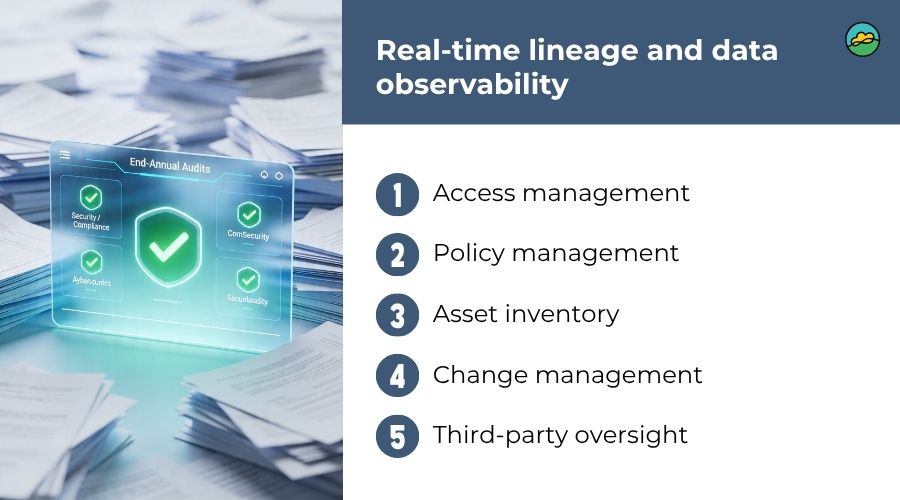
Access management
User access is one of the easiest things to let drift. People change roles, contractors leave, privileges accumulate, and dormant accounts stay active longer than they should. Continuous access reviews help keep the environment aligned with actual job needs instead of old assumptions.
Policy management
Policies are often written once and ignored until an audit forces an update. In a continuous model, policies are reviewed when business processes, technology, or regulations change. That keeps them useful instead of ceremonial.
Asset inventory
You can only secure what you can see. A current inventory of systems, applications, cloud services, and third-party connections is essential because controls depend on knowing what exists. Missing assets are one of the most common reasons audit evidence falls apart.
Change management
Changes happen constantly, and each one can affect control effectiveness. Continuous compliance means change records are tied to risk review, approval, and follow-up so the organization can explain not just what changed, but why it was allowed.
Third-party oversight
Control gaps often hide within vendors. Contracts, reviews, assessments, and monitoring should not live in a once-a-year cycle if the vendor has access to sensitive data or supports critical operations.
Read the “Powerful attestation of compliance: Key considerations for regulatory success” article to learn more!
How continuous compliance kills audit panic
The biggest advantage of continuous compliance is simple: it removes surprise. When control owners engage with current evidence and track exceptions in real time, the audit begins without panic.
That does not mean audits become effortless. It means the effort shifts from emergency collection to routine maintenance. Security teams spend less time chasing screenshots and more time analyzing trends. Compliance teams focus more on system improvement and less on filling in gaps.
This is where many organizations discover a useful truth: audit readiness and operational maturity are often the same thing. If a control is healthy enough to survive a year of normal business activity, it is probably healthy enough to withstand audit scrutiny too.
The role of automation
Automation is useful in continuous compliance, but it is not the whole answer. It helps collect evidence, remind owners of reviews, track control status, and surface exceptions quickly. That saves time and reduces the risk of manual error.
Still, automation only works when the underlying process is clear. If the control is poorly designed, automating it just speeds up the confusion. Effective continuous compliance uses automation to support people, not replace judgment.
The sweet spot is simple: automate the repetitive parts, standardize the evidence, and leave room for human review where context matters.
Why ownership matters more than tools
Many teams assume continuous compliance is mostly a software problem. It is not. You can buy every dashboard on the market and still fail if nobody knows who owns the control, who reviews exceptions, or who signs off on remediation.
Ownership is the real backbone of continuous compliance. Every control needs a clear owner, a review cadence, a defined evidence source, and a path for escalation if something breaks. Without that structure, evidence collection becomes guesswork and accountability disappears.
When ownership is clear, compliance becomes faster. Every audit turns into a scavenger hunt when it is unclear.
Read the “Master 9 infrastructure monitoring strategies for reliable IT performance” article to learn more!
A practical model for staying ready all year
The best continuous compliance programs usually follow a few simple habits.
- Keep a living control map
Map controls to risks, policies, systems, and owners in one place. If a control changes, the map should change too. That makes it easier to understand what is covered, what is missing, and what needs review. - Build evidence into the workflow
Do not wait until audit season to gather proof. Capture approvals, logs, review notes, and testing results as part of the normal process. If evidence is created where the work happens, it is easier to trust later. - Review exceptions quickly
Exceptions are not automatically failures, but they become risk when they are ignored. Track them, assign owners, set deadlines, and revisit them until they are resolved or formally accepted. - Rehearse audit requests
Consider audit preparation as a drill. Ask for sample evidence midyear and see how long it takes to produce. If the process is slow, that is a warning sign, not an inconvenience. - Use recurring reviews
Monthly, quarterly, and annual reviews should not feel ceremonial. They should be short, practical check-ins that confirm controls still operate the way they were designed to.
How the business benefits
Continuous compliance does more than reduce audit pain. It gives the business a cleaner view of risk, a faster response to change, and more confidence when customers, partners, or regulators ask hard questions.
It also improves teamwork. When people stop treating compliance as a last-minute fire drill, they become less defensive about it. Security feels less like an interruption and more like part of how the business stays credible.
That matters in client conversations too. A company that can show disciplined control management often feels more trustworthy than one that promises perfection once a year and improvises the rest of the time.
What leaders should stop doing
If your organization wants to kill the annual audit scramble, a few habits need to go.
- Stop waiting for the audit calendar to drive action.
- Stop storing evidence in personal folders and scattered email threads.
- Stop treating control ownership as a side task.
- Stop assuming that one successful audit means the system is healthy.
- Stop measuring compliance only by how well the last audit went.
Those habits keep companies stuck in reactive mode. Continuous compliance requires a different mindset: one that values steady control, visible accountability, and small corrections before they become major problems.
Industry’s first AI-native security assurance platform
Built for the AI era and designed to integrate GRC and cybersecurity, TrustCloud nullifies the reactive, bureaucratic, workflow-based, check-the-box GRC exercises and empowers CISOs to see everything, achieve accuracy, gain quick time-to-value, and build trusted business impact reporting.
The culture shift that makes it work
The hardest part of continuous compliance is rarely the process. It is the culture. Teams need to believe that ongoing control care is part of professional work, not an annoying extra.
That happens when leaders model the behavior. When managers ask about health control in regular reviews, when owners are expected to maintain evidence, and when compliance work is recognized as part of delivery rather than an obstacle, the culture starts to change.
People usually do not resist continuous compliance because they dislike order. They resist it because they think it will add friction without benefit. Once teams see that it actually reduces chaos, the idea becomes much easier to support.
A better way to think about audit season
Audit season should feel like a checkpoint, not a rescue mission. The organization should be able to demonstrate its work, as it has been ongoing throughout the year.
That mindset shift is what separates mature teams from stressed ones. Mature teams are not perfect, but they are usually prepared.
They know what changed, what remains open, and what evidence exists. That makes the audit less dramatic and the business far more resilient.
Summing it up
Continuous compliance is not about making life harder. It is about making control management normal, so the annual audit stops dictating everyone’s calendar and energy.
If you want to kill the audit scramble for good, stop thinking in terms of deadlines and start thinking in terms of habits. Keep controls alive, keep evidence current, keep owners accountable, and keep the business informed. The audit will still come, but it will no longer arrive like a crisis.
Frequently asked questions
What is continuous compliance and how is it different from traditional, audit-driven compliance?
Continuous compliance is an operating model where your controls, evidence, and risks are monitored and updated on an ongoing basis instead of being checked only in the run‑up to an annual audit. Instead of scrambling once a year to pull screenshots, policies, tickets, and access logs, you build a system where those artifacts are generated, tagged, and stored as part of everyday work.
The key mindset shift is from “prove we were compliant during this audit window” to “we are compliant all the time and can prove it on demand.” In practice, this looks like automated evidence collection from your cloud infrastructure, identity provider, ticketing system, and HR tools; mapped controls that update in real time when something changes; and dashboards that show your audit readiness across frameworks.
Traditional audit-driven compliance creates huge peaks of effort, large blind spots between audits, and an unhealthy culture where teams only care about controls when the auditor is booked. Continuous compliance spreads the effort evenly through the year, catches issues when they are small, and makes the eventual audit feel like exporting a report, not running a fire drill.
How does continuous compliance “kill” the annual audit scramble for good?
The annual audit scramble exists because evidence, ownership, and control status are all treated as ad hoc, manual tasks that only matter right before an auditor shows up. Continuous compliance removes that dynamic by building a permanent layer of automation, documentation, and accountability around your controls.
First, evidence is collected automatically from the systems you already use, cloud platforms, code repos, SSO, ticketing, and HR, so you are not chasing screenshots and one-off exports. Second, each piece of evidence is mapped to specific controls and frameworks, which means the same artifact can satisfy SOC 2, ISO 27001, HIPAA, or customer questionnaires at once instead of being rebuilt every time.
Third, health control is monitored in near real time: configuration drift, missing access reviews, or stale policies surface as small tasks in your regular workflow instead of massive remediation projects during audit season. By the time your auditor is scheduled, the heavy lifting is already done; you can grant them access to a live view of your controls and evidence rather than spinning up a special project team. Over a few cycles, this fundamentally changes how your organization experiences audits, from an all‑hands crisis to a routine check‑in.
What are the first practical steps to move from annual audits to a continuous compliance model?
The most effective way to start is not by buying a tool and hoping it fixes everything, but by taking a structured, incremental approach. Begin with an honest baseline: list your current frameworks, recent audits, and the systems where your control evidence actually lives (for example, AWS, GitHub, Okta, Jira, Google Workspace). Map your existing controls to these systems and identify the worst “scramble” moments from your last audit, typically access reviews, asset inventories, change management, and policy attestations. Those pain points are your first automation targets.
Next, implement a platform or set of integrations that can continuously pull objective evidence from these systems, timestamp it, and attach it to specific controls so it stays current without manual effort. Build a shared control library so you don’t duplicate work across SOC 2, ISO 27001, HIPAA, and customer questionnaires. Then, evolve your operating rhythm: schedule brief weekly or biweekly reviews of your compliance dashboard instead of month‑long sprints before the audit; assign clear owners for each control domain; and route issues as normal work tickets, not side projects.
Finally, socialize the new model with stakeholders, leadership, engineering, HR, and sales so they understand that staying audit‑ready all year reduces disruptions, accelerates deals, and avoids last‑minute heroics. Over time, these steps turn continuous compliance from a project into the way your organization simply operates.
