
Control Graph
Every control, mapped. Every finding, traceable.
The Control Graph is TrustCloud’s semantic model of your entire control environment — mapping every control to the policies, applications, risks, and contractual commitments it covers. It’s the substrate that grounds Assurance AI — making every output cited, auditable, and defensible.
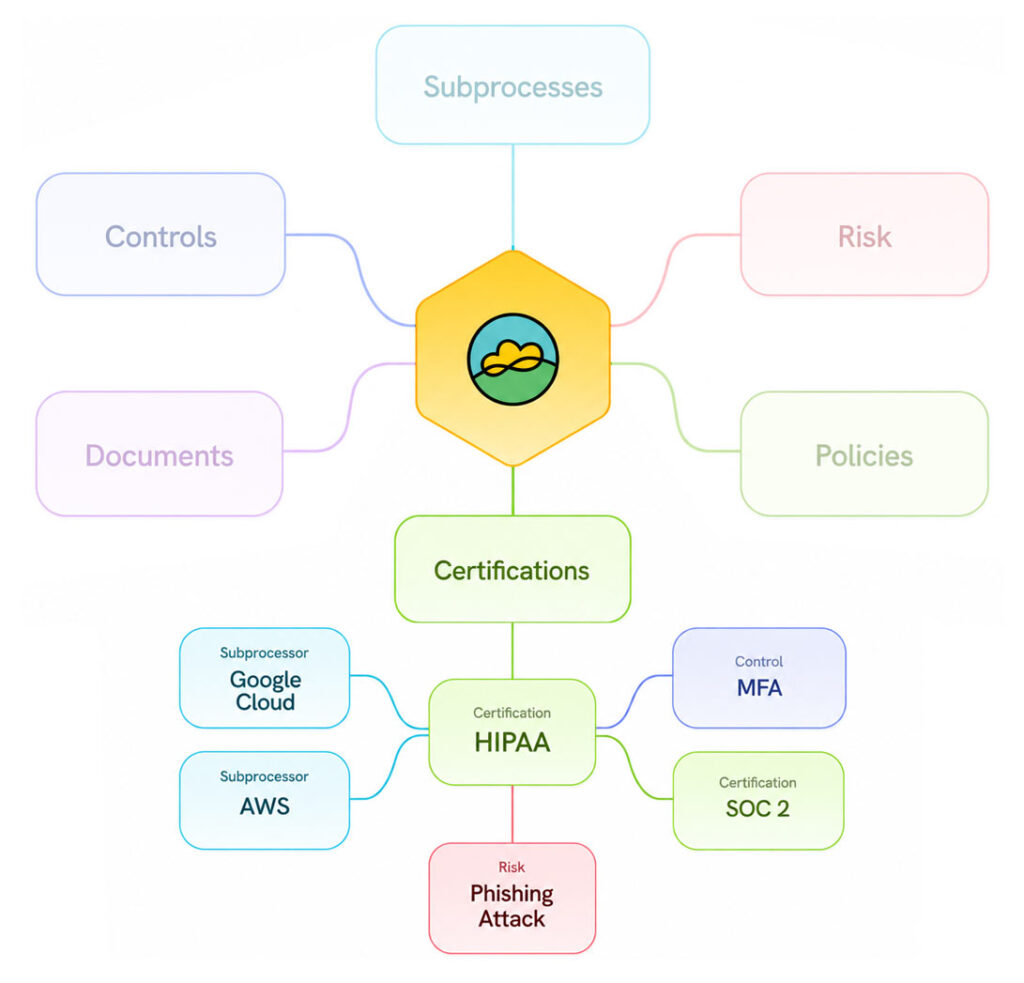
One Control Graph
Grounded in your entire stack via the Hybrid Data Fabric








What is the Control Graph?
Most GRC data lives in disconnected tools: a control in one system, the policy it supports in another, the risk it mitigates in a third. Nothing ties a finding to the obligation or revenue it actually affects. The Control Graph removes that fragmentation by holding those relationships in one place. It is also what makes AI trustworthy in GRC, because every answer resolves to a node in the graph, so the output can be cited and audited rather than taken on faith.
What makes the Control Graph distinct
- Built on a Common Control Framework (CCF), with bring-your-own-controls mapped in.
- Models technical, documentation, and process controls together.
- Segment-aware: data can be compartmentalized by business unit, product, or lifecycle.
- Feeds existing tools (ServiceNow IRM, Archer, Jira) rather than replacing them.
The Control Graph is the foundation of TrustCloud’s AI governance program.
ROI linking compliance directly to revenue
Application landscape continuously monitored
Days saved per user, per year
Enterprise customers in regulated industries
The problem
GRC data is scattered and point-in-time. AI cannot operate on scatter.
No single source of truth
GRC teams maintain parallel records across spreadsheets, GRC tools, and risk registers. Every audit starts from scratch. No shared context, no institutional memory.
AI on ungrounded data hallucinates confidently
AI applied to fragmented, unverified GRC data cannot produce trusted output. Without an auditable Control Graph, AI recommendations are indefensible, and boards, regulators, and auditors know it.
Findings disconnected from business impact
A failing control has no line of sight to the contract, regulation, or revenue at risk — so remediation is prioritized by whichever team complains loudest, not by actual business exposure.
Scope defined differently every assessment
Every audit, every questionnaire, every risk assessment re-scopes from the beginning. No common framework means no repeatability, no comparability, and no cumulative learning.
The solution
One semantic model of your entire control environment
The Control Graph connects every control with the policies, applications, risks, and contractual commitments it covers — giving Assurance AI a defensible substrate to reason from, and every stakeholder a single source of truth.
- Bring-your-own-controls — map to any framework or custom CCF
- Multi-dimensional AI for GRC— technical, documentation, and process controls in one graph
- Auditable AI outputs cited and traceable to a node in the Control Graph — hallucination-free
- Feeds ServiceNow IRM, Archer, and Jira — augments existing tools instead of replacing them
Common Control Framework
Bring-Your-Own Controls
IRM Integration
Segment-Aware
Cited & Auditable AI
Grounding AI in the Control Graph is how TrustCloud delivers the assurance principle behind PLAID, our approach to enterprise AI.
Architecture
Map. Connect. Prove.
The Control Graph is built in three stages — ground it in the Hybrid Data Fabric (150+ integrations across cloud, hybrid, and on-prem), define the control universe, associate it to the artifacts that give it context, then let Assurance AI and Continuous Control Monitoring reason over it with full auditability.
01
MAP
Common Control Framework
Define your control universe against the CCF — technical, documentation, and process controls mapped to every GRC objective your organization is accountable for. Bring-your-own-controls supported.
02
CONNECT
Semantic Association
03
PROVE
Auditable AI Reasoning
Assurance AI is grounded in your Hybrid Data Fabric and Control Graph. Every recommendation carries a citation traceable to a specific graph node — making every output auditable, defensible, and actionable, hallucination-free. Human-in-the-loop approval on every action, governed to ISO 42001 and NIST AI RMF.
Graph artifacts: Control definitions · Policy documents · Regulatory obligations · Application inventory · Risk register · Contractual commitments · Customer obligations · Audit evidence · Remediation tasks
PRODUCTION RESULTS
One source of truth. Proven at scale.
Live outcomes from Global 2000 deployments — the Control Graph in production, not in a proof of concept.
FORTUNE 100 TECHNOLOGY
24 controls
Within 90 days: 24 controls automated across 12 data feeds. Every finding traced to a specific business obligation, giving the CISO a defensible residual-risk view benchmarked against industry.
FORTUNE 100 PHARMACEUTICAL
96%
Digital Crown Jewels coverage scaled from ~20% with manual questionnaires to 96% continuously monitored — enabled by a unified Control Graph mapping controls to every covered application.
GLOBAL 2000 ENERGY COMPANY
400 controls
Mapped 400 controls to NIST 800-53 using TrustOps and TrustRegister with the Control Graph as the unifying layer — supporting a SOC 2 audit while maintaining Jira for exception management.
“Without a Control Graph, AI output is not defensible. The moment you apply AI to fragmented, unstructured GRC data, you get answers that cannot be traced — and answers that cannot be traced are answers that cannot be trusted.”
TrustCloud product position on AI and the Control Graph
(from Continuous Control Monitoring documentation)
A category shift
From siloed records to one connected graph
Siloed GRC
No Control Graph
Controls tracked in spreadsheets, disconnected from risk registers and policy documents
No line of sight from a finding to the obligation, contract, or revenue it threatens
AI applied to unstructured data produces output that cannot be cited or defended
Scope rebuilt from scratch every assessment — no repeatability, no cumulative assurance
TrustCloud
Control Graph
One semantic model connecting controls, policies, risks, applications, and obligations
Every finding automatically traced to the contract, regulation, and revenue exposure it affects
AI grounded in the graph produces cited, auditable output — defensible to boards and regulators
One CCF, continuously updated — shared context for GRC, audit, security, and engineering teams
FAQ
What is the Control Graph?
The Control Graph is TrustCloud’s connected model of a control environment that links every control to the policies, applications, risks, and obligations it relates to, so findings and auditable AI outputs can be traced to a specific, verifiable source.
Why does AI in GRC need a Control Graph?
AI applied to fragmented, unverified GRC data produces output that cannot be traced or defended. A Control Graph gives the AI a grounded source, so every recommendation resolves to a specific, cited node and can be audited.
How does the Control Graph make AI output auditable?
Every output carries a citation traceable to a node in the graph: a control, policy, risk, or obligation. Boards, regulators, and auditors can verify the basis for each answer rather than take it on faith.
Does the Control Graph replace ServiceNow or Archer?
No. It feeds ServiceNow IRM, Archer, and Jira, adding a connected control layer on top of the tools teams already use.
Build the foundation for defensible GRC
One source of truth. Auditable AI. First controls live in weeks.
