

GRC transformation is the organizational change from running governance, risk, and compliance as periodic, check-the-box paperwork to running it as continuous, AI-native cyber risk assurance measured in business outcomes. It is not a tooling upgrade. It is a change in what you are asked to prove. The old question was whether the work got done by audit time. The new question is whether risk is understood and the controls meant to manage it are working right now.
For enterprise CISOs, that shift has a destination. GRC becomes Cyber Risk Assurance: a high-confidence, continuous, business-impact view of whether you are measuring and managing risk correctly.
What does GRC transformation change?
At its simplest, GRC transformation changes three things:
- How often you know your risk posture: from point-in-time to continuous.
- How you prove it: from sampled evidence and self-attestation to cited, continuously collected evidence.
- What you measure: from documentation produced to business impact delivered.
The transformation even changes what the letters stand for.

Sravish Sridhar
CEO, TrustCloud
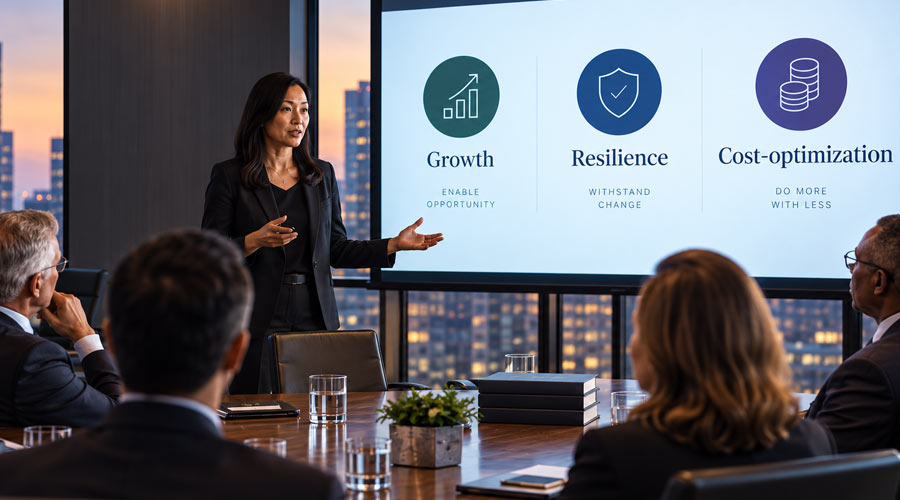
“What used to be called GRC, governance, risk, and compliance, should now stand, from a CISO standpoint, for growth, resilience, and cost-optimization.”
Reframed that way, the GRC program stops being an annual scramble to satisfy an auditor and becomes a continuous discipline that moves the business forward.
What is wrong with traditional GRC?
Traditional GRC is point-in-time and sampling-based. You gather evidence for an audit, attest that controls are in place, and move on until the next cycle. The catch is that a control can pass in one quarter and drift in the next, so a folder full of attestations tells you what was documented, not what is true today. And automating that same workflow does not fix it: faster paperwork is still paperwork.
I have made the full case for why that model is now a liability in the first article of a two-part series: The hidden cost of reasonable assurance. The short version: point-in-time GRC is obsolete, and the question is what replaces it.
What does GRC transform into?
The destination is Cyber Risk Assurance. It answers the question every board eventually asks its CISO: how do we know, confidently, that we are measuring risk correctly?
Assurance sits a level above compliance. Compliance is the artifact, but managed risk is the outcome. A transformed program proves that risk is understood and that effective controls are in place, not simply that a box was ticked. That is why the emphasis moves from proof of output to proof of impact and outcomes. A transformed GRC program will clearly prove business impact.
How does GRC transformation actually work?
The mechanism is continuous control monitoring of a common control framework, driven by AI. Instead of sampling evidence once a quarter, the program tests your controls against evidence as it is collected, and each finding ties back to a business objective.
In TrustCloud’s approach, the AI reasons over a Control Graph so its output is cited, never invented, which is what turns “we think the control is working” into evidence that it is. I walk through how that continuous model works in practice in The rise of continuous, high-confidence assurance.
Does GRC transformation mean replacing my GRC platform?
No. If you already own a GRC or IRM platform, transformation does not mean ripping it out. We don’t replace it. We make it work. The transformation layer sits underneath your existing GRC or IRM stack as the automation and assurance layer that feeds your system of record, so your business does not have to learn yet another tool.
How do you measure GRC transformation?
You measure it in business outcomes, not activity. A transformed program should make security strategic to the business, not a cost center, and it shows up in three places:
- Growth: security accelerates revenue instead of stalling it.
- Resilience: you can prove your risk posture continuously.
- Cost-optimization: you do the work once instead of repeating it for every framework.
In practice, that shows up in concrete ways, such as audits that take three days instead of twenty-eight, and a security program whose value the board can finally see.
How to tell if your GRC program is actually transforming
A few signs tell you quickly:
- You can answer “are we compliant right now?” without launching a fire drill.
- A failing control shows up as an alert you catch in days, not a surprise you discover at the next audit.
- Your board report starts from business objectives and the risks to them, not a count of controls or a list of frameworks.
- Evidence collects itself continuously, so audit prep is a review rather than a scramble.
- Your team spends its time on judgment and remediation, not on gathering screenshots.
If you recognized your program in most of those, you are already well into the shift. If you recognized it in none, the gap is usually not budget or tooling, it is knowing where to start. Either way the destination is the same: a program that can prove, on any given day, that risk is understood and handled.
FAQ
How is GRC transformation different from GRC automation?
Automation speeds up an existing workflow. Transformation changes what you are proving. Faster paperwork is still paperwork; transformation moves you from proving work was done to proving that risk is managed.
Is GRC transformation the same as Cyber Risk Assurance?
They are two ends of the same move. GRC transformation is the change you make; Cyber Risk Assurance is where it lands, the continuous, high-confidence view of risk you end up with.
Where should a CISO start with GRC transformation?
Start with risk, not tooling. Identify the business objectives your program protects, map the controls that matter to them, and make the evidence for those controls continuous before worrying about the rest.
Does GRC transformation replace compliance?
No. Compliance is still the artifact you produce; transformation changes how you get there. When you manage risk continuously, compliance becomes a byproduct rather than an annual event.
How long does GRC transformation take?
It is a program, not a project, so the honest answer is that it is ongoing. The early wins come fast, though. Teams usually feel the difference in audit preparation and board reporting well before the full program is mature.
